
Why Recruiter Collaboration Improves Hiring Outcomes

TL;DR:
- Recruiter collaboration enhances hiring speed and quality with shared criteria, structured feedback, and mutual accountability.
- Most teams miss opportunities for better outcomes by neglecting early alignment, fast feedback, and competency-based evaluations.
Recruiter collaboration is the strategic partnership between recruiters and hiring managers that drives faster, higher-quality hiring outcomes through shared accountability and clear communication. Organizations with strong recruiter and hiring manager collaboration achieve 40% faster time-to-hire and 25% higher quality of hire scores. That gap between collaborative and siloed teams is not marginal. It is the difference between filling a role in three weeks and watching it drag into three months while your best candidates accept other offers. This article breaks down why recruiter collaboration improves outcomes, what structured frameworks make it work, and where most teams quietly go wrong.
Why recruiter collaboration improves outcomes: the core mechanics
Collaboration in recruiting is not about adding more meetings. It is about replacing guesswork with shared language, aligned criteria, and mutual accountability. The industry term for this model is “recruiting as a business partner,†and it shifts the recruiter’s role from order-taker to strategic advisor.

The numbers make the case clearly. Teams using structured collaborative hiring report 30% faster hiring speeds, 25% lower turnover rates, and 20% more accurate hiring decisions. Lower turnover alone justifies the investment. A bad hire costs at least 30% of a first-year salary, and structured collaboration reduces adverse impact rates by up to 35%.
The root cause of most hiring failures is not a weak talent pool. Most hiring failures originate in role scoping, when the brief is vague, the success criteria are undefined, and the recruiter is handed a job description rather than a business problem to solve. Collaboration fixes this at the source.
How do structured frameworks between recruiters and hiring managers work?
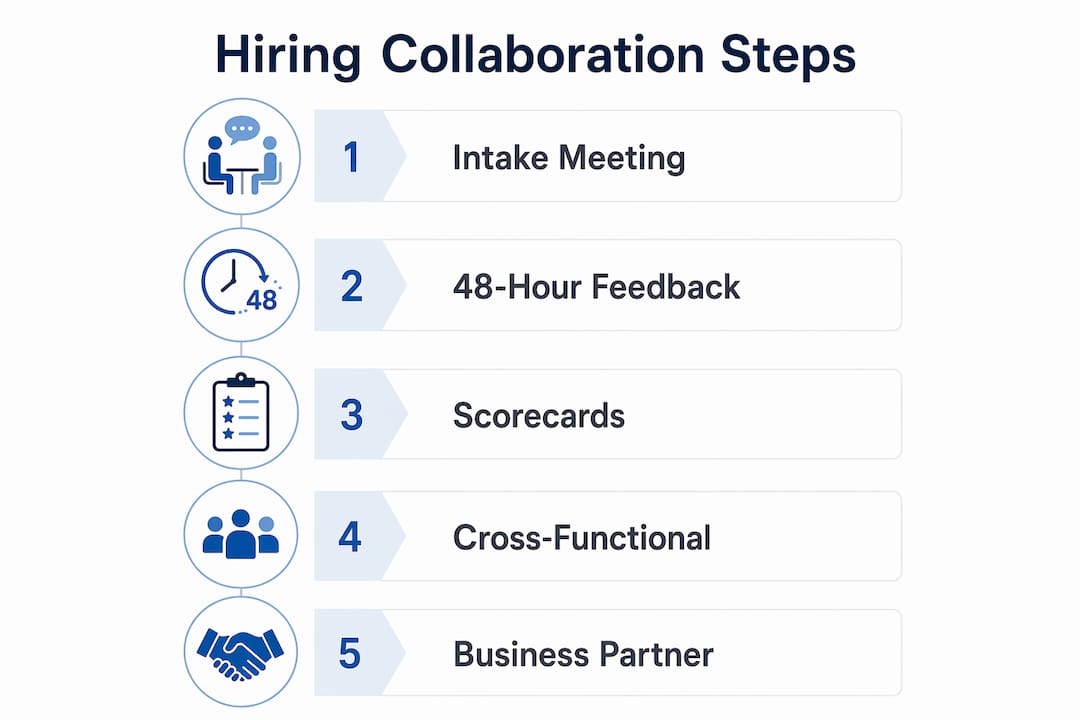
The most effective collaboration frameworks share three features: a structured intake process, a defined feedback cadence, and scorecard-based evaluation. Each one removes a specific failure point.
The intake meeting as the foundation
A structured 30–45 minute intake session replaces guesswork with shared language, setting expectations and feedback timelines before a single candidate is sourced. This is where the recruiter and hiring manager align on what “great†looks like, not just what the job description says. The intake meeting should produce a written candidate profile, agreed evaluation criteria, and a clear timeline with milestones.
Most teams skip or rush this step. That decision costs them weeks later when the recruiter and manager disagree on the third shortlist in a row.
The 48-hour feedback SLA
Successful teams implement 48-hour feedback SLAs to maintain hiring momentum. This is a service-level agreement: the hiring manager commits to reviewing and responding to candidate submissions within two business days. Without this commitment, pipelines stall, top candidates disengage, and the recruiter loses credibility with both the candidate and the business.
The SLA works in both directions. The recruiter commits to submitting only candidates who meet the agreed profile. The manager commits to responding with specific, scored feedback rather than vague signals.
Scorecards over gut feel
Scorecards replace subjective assessments with specific, data-driven feedback. Instead of “not a fit,†a scorecard forces the evaluator to rate the candidate against defined competencies with a numeric score and a written rationale. This creates a feedback loop the recruiter can actually use. It also builds a data set over time that reveals patterns in what predicts success in a given role.
Pro Tip: Track “time to alignment†as a core metric. This measures the days from requisition opening to the moment the recruiter and hiring manager agree on a candidate profile. Reducing time to alignment by five days can shave weeks off the total time-to-fill. Most teams obsess over time-to-fill while ignoring the upstream metric that drives it.
For a practical starting point, the step-by-step recruitment planning guide from Sparkly walks through how to structure these early alignment conversations for maximum impact.
What does a recruiter as a business partner actually do?
The business partner model redefines what recruiters are responsible for. Hiring managers often see recruiters as “CV pushers†rather than strategic advisors. Shifting that perception is the prerequisite for genuine collaboration.
A recruiter operating as a business partner does four things differently:
- Joins headcount planning early. The recruiter is in the room when the business decides to open a role, not after the job description is already written. This allows them to challenge assumptions, clarify the business need, and shape the role around outcomes rather than tasks.
- Challenges the brief. Instead of accepting a job description at face value, the recruiter asks what success looks like at 12 months. This ties the assessment criteria to business outcomes, not just credentials.
- Designs interview architecture. The recruiter assigns distinct competencies to each interviewer, so every round tests something different. This eliminates redundant rounds and gives the hiring team a complete picture of the candidate.
- Measures hire quality, not just activity. The shift from tracking time-to-fill to tracking 90-day retention and hiring manager satisfaction is the clearest signal that a team has moved into the business partner model.
Pro Tip: Implement a “License to Hire†model for hiring managers. This means training managers on structured interviewing and assessment before they join any interview panel. Moving beyond transactional handoffs and building manager capability is one of the highest-leverage investments a recruiting team can make.
Teams that want to go deeper on this approach will find the hiring process best practices resource from Sparkly useful for building alignment across the full hiring team.
How does cross-functional collaboration elevate recruitment quality?
The benefits of recruiter teamwork extend well beyond the recruiter and hiring manager pairing. Involving HR, marketing, employees, and business leaders in structured recruitment efforts improves clarity, reduces bias, and protects candidate experience. This is where improving hiring outcomes together becomes a genuine organizational capability rather than a two-person effort.
The key to making cross-functional collaboration work without creating chaos is competency allocation. Collaborative hiring reduces redundant interview rounds by assigning each stakeholder a unique competency to assess. The hiring manager evaluates technical judgment. A senior team member assesses collaboration style. HR evaluates culture and values alignment. No one asks the same questions twice.
This approach also improves employer branding. When candidates experience a coordinated, purposeful interview process, they form a stronger impression of the organization. Disorganized, repetitive interviews signal internal dysfunction. Structured, distinct rounds signal a team that knows what it wants.
The guardrail here is process discipline. More stakeholders means more scheduling complexity and more risk of candidate fatigue. The recruiter’s job in a cross-functional model is to act as the process owner, keeping rounds focused, timelines tight, and feedback consolidated.
Pro Tip: Assign a single point of contact for every candidate, regardless of how many stakeholders are involved. Candidates should never have to wonder who to follow up with or where they stand in the process. This one practice alone significantly reduces candidate drop-off during extended hiring processes.
For global teams managing this complexity across multiple markets, the global talent acquisition best practices guide offers practical frameworks for coordinating cross-functional hiring at scale.
What are the most common collaboration pitfalls in recruiting?
The most damaging pitfall is mistaking collaboration for consensus. Misunderstanding collaboration as group interviewing leads to delays, scheduling gridlock, and candidate fatigue without improving decision quality. Collaboration means structured input from the right people at the right time, not unanimous agreement from everyone involved.
The second pitfall is vague feedback. “Not a fit†tells a recruiter nothing. It does not explain what was missing, whether the brief needs adjusting, or whether the sourcing strategy is off. Vague feedback compounds over time, creating a cycle where the recruiter submits candidates, the manager rejects them without explanation, and the role stays open for months.
Here is what the data shows about the cost of getting this wrong:
- Organizations without a consistent collaborative interview process are five times more likely to make a bad hire.
- 69% of organizations struggle to fill full-time roles due to recruiter and manager misalignment.
- Teams with excellent partnerships are more than twice as likely to exceed their annual hiring goals and have 90% fewer hiring mistakes.
The fix for vague feedback is the scorecard system described earlier. The fix for process delays is asynchronous review. Asynchronous feedback systems allow hiring managers to review recorded interviews or written submissions on their own schedule, without requiring everyone to be available at the same time. This protects hiring velocity without sacrificing input quality.
AI-powered tools that automate intake note capturing, pipeline ranking, and interview feedback analytics free recruiter time for advisory roles. This makes structured collaboration scalable even in high-volume hiring environments. The role of data in recruiting is expanding rapidly, and teams that build data habits now will have a significant advantage as these tools mature.
Key Takeaways
Recruiter collaboration improves hiring outcomes by replacing guesswork with shared criteria, structured feedback, and mutual accountability across every stage of the hiring process.
| Point | Details |
|---|---|
| Structured intake meetings | A 30–45 minute intake session aligns the recruiter and hiring manager on criteria before sourcing begins. |
| 48-hour feedback SLAs | Committing to fast, specific feedback keeps pipelines moving and top candidates engaged. |
| Time to alignment metric | Tracking days to a shared candidate profile predicts time-to-fill better than any activity metric. |
| Business partner model | Recruiters who join headcount planning early reduce role scoping failures and improve hire quality. |
| Competency-based interview design | Assigning unique competencies per stakeholder eliminates redundant rounds and improves decision accuracy. |
The shift that most recruiting teams are not making yet
I have worked with enough hiring teams to know that the biggest obstacle to recruiter collaboration is not process. It is perception. Hiring managers who see recruiters as administrative support will never share ownership of a hiring outcome. They will submit a job description, wait for candidates, and blame the recruiter when the shortlist misses the mark.
The teams that get this right treat hiring as a shared business outcome with shared KPIs. When the hiring manager’s performance review includes time-to-fill and 90-day retention, the dynamic changes immediately. Suddenly, they show up to intake meetings prepared. They return feedback within 48 hours. They invest in interview training because they understand that their judgment is part of the system.
What excites me about where this is heading is the role of AI in freeing recruiters from administrative work. When AI handles pipeline ranking, note-taking, and scheduling, recruiters get their time back for the advisory conversations that actually move the needle. That is not a future state. Teams using these tools today are already seeing the shift. The recruiter becomes a talent strategist, not a logistics coordinator.
The uncomfortable truth is that most organizations are still measuring recruiting on activity metrics: requisitions opened, candidates submitted, days to fill. These numbers tell you how busy the team is. They do not tell you whether the team is hiring the right people. The shift to quality metrics, shared accountability, and structured partnership is not a nice-to-have. It is the only model that scales.
— Mikk
How Sparkly supports smarter recruiter collaboration
Recruiter collaboration produces better decisions when everyone is working from the same quality of information. The challenge is that human judgment, even when structured, carries blind spots that no intake meeting or scorecard fully eliminates.
Sparkly addresses this directly. The platform merges personality assessment, psychometric data, AI analysis, and Human Design into a single computed insight that HR teams can use before, during, and after interviews. Rather than assessing skills alone, Sparkly focuses on personality fit, because skills can be learned but wiring cannot. This gives recruiters and hiring managers a shared, objective foundation for every conversation. Explore how SaaS-driven HR assessment can sharpen the quality of your collaborative hiring decisions and reduce costly mismatches before they happen.
FAQ
Why does recruiter collaboration improve hiring speed?
Collaboration reduces the time recruiters and hiring managers spend realigning on candidate criteria. Teams with structured collaboration report 30% faster hiring speeds because shared criteria and fast feedback loops eliminate the back-and-forth that stalls most pipelines.
What is the “time to alignment†metric?
Time to alignment measures the days from a requisition opening to the moment the recruiter and hiring manager agree on a candidate profile. It is the highest-impact predictor of time-to-fill, and reducing it by five days can cut weeks from the total hiring timeline.
How does collaborative hiring reduce bad hires?
Organizations without a consistent collaborative interview process are five times more likely to make a bad hire. Structured collaboration aligns evaluation criteria early, reduces bias through scorecard-based feedback, and ensures every interviewer assesses a distinct competency.
Does involving more stakeholders slow down hiring?
Not when competency allocation is used correctly. Collaborative hiring eliminates redundant rounds by assigning each stakeholder a unique area to assess, which speeds up decision-making rather than slowing it down.
What is the recruiter business partner model?
The recruiter business partner model positions recruiters as strategic advisors who join headcount planning before roles are defined, challenge job briefs, design interview architecture, and measure success by hire quality and retention rather than activity metrics alone.