What Is Recruiter Interview Intelligence? 2026 Guide

TL;DR:
- Interview intelligence uses AI to record, transcribe, and analyze interviews, transforming unstructured conversations into structured, searchable data. It enhances decision-making, reduces bias, and improves recruiter consistency by linking interview signals to outcomes, but relies on well-defined rubrics and process discipline. Successful implementation depends on proper preparation, integration, and training, leading to smarter, more equitable hiring practices.
Recruiter interview intelligence is an AI-powered system that captures, transcribes, and analyzes interview conversations to convert unstructured dialogue into structured, searchable hiring data. The industry term for this category is “interview intelligence,†and it sits at the intersection of natural language processing, behavioral analysis, and recruitment workflow automation. Transcription accuracy now exceeds 94% on professional audio streams, which means the data you collect is reliable enough to act on. For HR professionals and hiring managers, this technology addresses one of recruiting’s oldest problems: the moment an interview ends, most of what was said disappears. Interview intelligence fixes that.
What is recruiter interview intelligence and how does it work?
Interview intelligence is defined as a technology category that uses AI to capture, transcribe, and analyze interviews, converting unstructured content into searchable, auditable data. The process runs in four distinct stages, each building on the last.
- Capture and transcription. The platform records audio or video from the interview and produces a transcript with speaker labels. Accuracy above 94% means you get a reliable record, not a rough approximation.
- Content analysis. The AI scans the transcript for competency evidence, categorizes questions by type, and tags candidate responses against predefined criteria. This is where raw conversation becomes structured evaluation data.
- Behavioral signal analysis. Advanced platforms layer in tone, sentiment, and pacing signals. These signals do not replace human judgment. They flag patterns worth reviewing, such as a candidate who answers confidently on technical questions but hedges on collaboration scenarios.
- Outcome correlation. The most powerful layer connects interview signals to 90-day retention and performance review data. Over time, this builds a predictive model specific to your organization.
- ATS integration and fit scoring. Platforms push structured summaries and fit scores directly into your applicant tracking system, so hiring managers see ranked insights without leaving their existing workflow.
One distinction worth knowing: interview intelligence supports human-led later-stage interviews, while AI interviewing automates high-volume first-round screenings. They solve different problems at different stages of the funnel.
Pro Tip: Set up your competency framework inside the platform before your first recorded interview. The AI can only tag what you have defined. Garbage in, garbage out applies here more than anywhere else.
What are the main benefits and challenges of interview intelligence?
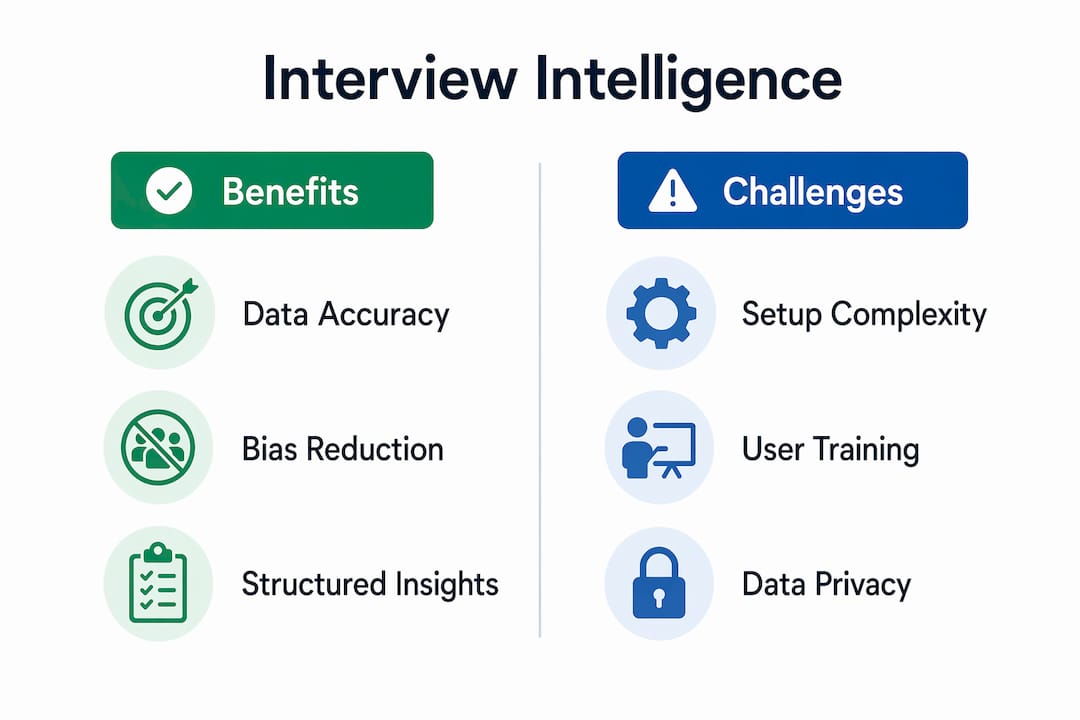
The benefits of interview intelligence are real, but they are not automatic. You get out what your process puts in.
Core benefits:
- Bias reduction. 48% of HR managers admit unconscious bias affects their recruiting decisions. Interview intelligence anchors evaluations to evidence from the transcript, not to post-interview impressions shaped by recency or affinity.
- Data retention. Most organizations retain essentially zero usable interview data annually. Interview intelligence creates an institutional knowledge base that links questions, responses, and eventual hire outcomes. That data becomes a coaching asset and an audit trail.
- Interviewer calibration. When every interviewer uses the same rubric and the AI captures what was actually asked, score calibration across panels becomes far more consistent. You can spot the interviewer who never asks follow-up questions or always rates candidates higher on Fridays.
- Speed for hiring managers. Short AI-extracted structured snippets give hiring managers a two-minute read on each candidate instead of a 60-minute transcript. That is the difference between a tool people use and one they ignore.
Common challenges:
- Data overload. Full transcripts are rarely the right deliverable. Platforms that surface everything create decision fatigue. Prioritize summary views.
- Process dependency. Without structured interview rubrics, AI summaries lack focus and amplify existing inconsistencies rather than correcting them. The technology does not fix a broken process. It makes a broken process more visible.
- Adoption friction. Recruiters who feel monitored resist the tool. Frame it as a coaching resource, not a surveillance system.
Pro Tip: Run a pilot with one hiring team before rolling out organization-wide. Use the pilot data to refine your rubrics, then scale. Skipping this step is the most common reason implementations stall.
How does interview intelligence complement recruiter interview techniques?
The most persistent misconception about interview intelligence is that it replaces the recruiter. It does not. Interview intelligence shifts note-taking from humans to AI, freeing recruiters to focus entirely on listening and evaluating during the conversation itself.

Think about what actually happens when a recruiter is furiously typing notes mid-interview. They miss the candidate’s body language. They miss the pause before a difficult answer. They miss the follow-up question they should have asked. Interview intelligence removes that cognitive split. The recruiter stays present. The AI handles documentation.
This shift also strengthens structured interviewing. When the platform records which questions were asked and in what order, you can verify that every candidate received the same evaluation conditions. That consistency is the foundation of a legally defensible and statistically meaningful hiring process.
| Recruiter skill | Without interview intelligence | With interview intelligence |
|---|---|---|
| Active listening | Divided between listening and note-taking | Fully present during the conversation |
| Score calibration | Based on memory and handwritten notes | Anchored to transcript evidence and rubric tags |
| Candidate comparison | Subjective recall across multiple interviews | Structured snippets enabling side-by-side review |
| Coaching and development | Limited feedback loops for interviewers | Analytics showing question quality and scoring patterns |
The role of AI in recruitment is not to automate human judgment. It is to give human judgment better raw material to work with. Interview intelligence is the clearest example of that principle in action.
What practical steps should HR leaders take to implement interview intelligence?
Implementation succeeds or fails in the preparation phase, not the deployment phase. Follow these steps in order.
- Define competency-based rubrics first. Before you touch any platform, map the competencies for each role family. Specify what a strong, adequate, and weak response looks like for each competency. This is the scoring framework the AI will use to structure its output.
- Train recruiters on evidence-based evaluation. Interview intelligence surfaces evidence. Recruiters still decide what that evidence means. Train your team to cite specific transcript moments in their evaluations rather than relying on overall impressions.
- Prioritize structured summaries over raw transcripts. Configure the platform to deliver two-minute structured snippets to hiring managers. Full transcripts belong in the audit file, not the decision workflow.
- Integrate directly with your ATS. Fit scores and structured summaries should appear inside the candidate record in your applicant tracking system. Any step that requires a recruiter to switch platforms will be skipped under time pressure.
- Build coaching loops from analytics. Review interviewer-level data monthly. Which interviewers ask the most competency-aligned questions? Which ones show the widest scoring variance across similar candidates? Use that data in one-on-one coaching sessions. This is how you improve recruiter effectiveness over time, not just hiring outcomes.
The long-term value of interview intelligence comes from linking behavioral signals to actual hire success metrics. Organizations that close that feedback loop build a proprietary hiring model that gets sharper with every cohort. Those that treat it as a transcription service miss the point entirely. Employers facing recruitment challenges consistently report that structured data from interviews is one of the hardest gaps to close without dedicated tooling.
Key Takeaways
Interview intelligence delivers its full value only when structured rubrics, trained recruiters, and ATS integration work together as a single system.
| Point | Details |
|---|---|
| Define rubrics before deployment | Competency frameworks must exist before AI can tag and structure interview responses reliably. |
| Bias reduction requires evidence anchoring | With 48% of HR decisions affected by unconscious bias, transcript-based evaluation is a measurable corrective. |
| Data retention builds institutional knowledge | Most organizations lose all interview data post-hire; intelligence platforms create auditable, searchable records. |
| Summaries beat transcripts for decisions | Two-minute structured snippets drive faster, clearer hiring decisions than full transcript review. |
| Outcome correlation is the highest-value layer | Connecting interview signals to 90-day retention data builds a predictive hiring model unique to your organization. |
Interview intelligence is changing what it means to be a great recruiter
I have watched the recruiting profession wrestle with the same tension for years: we want data-driven decisions, but interviews are inherently human and messy. Interview intelligence does not resolve that tension. It reframes it in a way that actually helps.
The recruiters I have seen get the most from these tools are not the ones who trust the AI most. They are the ones who use it to trust themselves more. When you have a transcript to reference, you stop second-guessing your read on a candidate. You stop letting the last interview of the day color your memory of the first. You make the call based on what was actually said.
What concerns me about the current adoption curve is that too many HR teams are buying the technology before they have built the process. Structured interview practices are not a feature you configure in a platform. They are a discipline you build in your team. The platform amplifies whatever process you bring to it.
The organizations that will win with interview intelligence in 2026 are the ones treating it as a capability-building investment, not a shortcut. They are using the analytics to coach interviewers, not just to score candidates. They are closing the feedback loop between interview data and performance outcomes. And they are building something no off-the-shelf tool can replicate: a hiring model trained on their own people, in their own context.
That is the real promise of this technology. Not faster hiring. Smarter hiring that gets smarter over time.
— Mikk
How Sparkly supports smarter hiring beyond the interview
Sparkly takes interview intelligence a step further by addressing what most platforms miss entirely: personality fit.
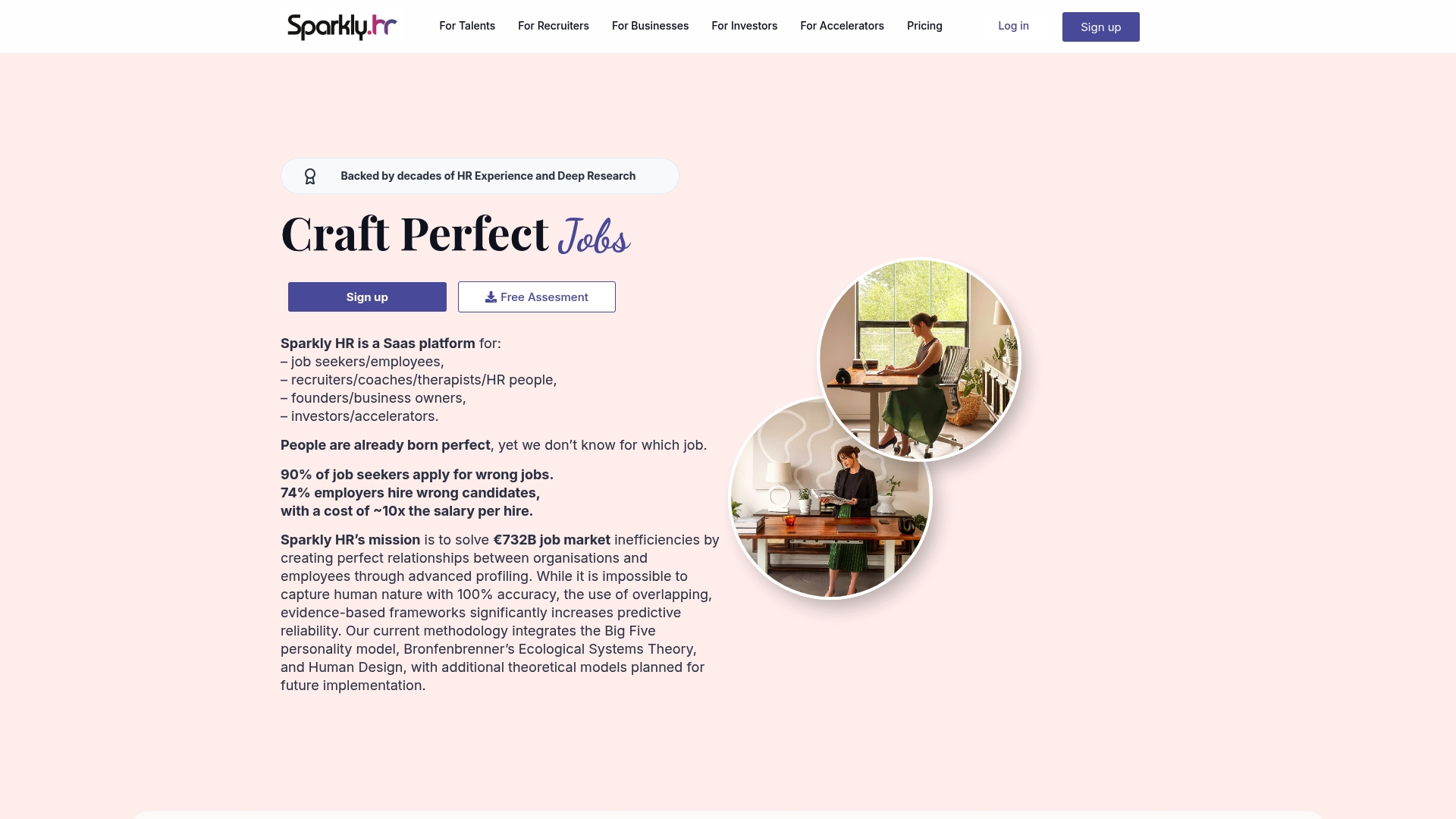
Skills can be learned. Personality shapes how someone performs, collaborates, and grows inside a specific role and team. Sparkly merges psychometric assessments, AI analysis, Human Design data, and human observation into a single computed insight layer that HR teams can use before, during, and after interviews. The result is a personality-driven hiring approach that reduces mismatch and costly exits. If you are building out your interview intelligence practice and want to add a deeper layer of candidate understanding, Sparkly’s personality-based assessment tools are built exactly for that next step. âš¡ï¸
FAQ
What is interview intelligence in recruiting?
Interview intelligence is a technology category that uses AI to capture, transcribe, and analyze interview conversations, converting them into structured hiring data. It integrates with ATS platforms and helps recruiters make evidence-based decisions.
How does interview intelligence reduce bias in hiring?
By anchoring evaluations to transcript evidence and predefined rubrics rather than post-interview impressions, interview intelligence reduces the influence of unconscious bias. Research shows 48% of HR managers acknowledge bias affects their recruiting decisions.
Is interview intelligence the same as AI interviewing?
No. Interview intelligence supports human-led, later-stage interviews as a decision-support tool. AI interviewing automates high-volume first-round screenings without a human interviewer present.
What is interview assessment in the context of AI tools?
Interview assessment refers to the structured scoring of candidate responses against competency rubrics. AI-powered platforms automate this tagging process, but the rubrics themselves must be defined by HR teams before deployment.
What happens if you use interview intelligence without structured rubrics?
Without clear rubrics and standardized question sets, AI summaries lack focus and amplify existing process inconsistencies rather than correcting them. Structured interviewing is a prerequisite, not an optional add-on.