
The Role of SaaS in Modern Recruiting: 2026 Guide

TL;DR:
- SaaS recruitment software centralizes hiring processes, reducing time-to-hire and improving candidate quality. It integrates with existing tools and uses AI-driven assessments to make faster, more accurate decisions. Platforms like Sparkly add personality and team-fit insights for better long-term talent matching.
SaaS recruitment software is defined as cloud-hosted hiring technology that centralizes candidate sourcing, screening, and workflow management in a single platform. The role of SaaS in modern recruiting has shifted from a convenience to a competitive necessity. 72% of organizations have transitioned to cloud-based HR tech, reducing time-to-hire by 30–50%. That number tells you something critical: the companies still running spreadsheets and email threads are losing candidates to employers who respond faster, screen smarter, and move with purpose.
How does SaaS reshape the role of recruiting today?
Cloud-based recruitment software, also called a SaaS ATS (Applicant Tracking System), does more than store resumes. It replaces a chain of disconnected tools with one connected system that tracks every candidate, every conversation, and every decision. The practical result is that recruiters spend less time on administration and more time on the work that actually fills roles.

The efficiency gains are real and measurable. AI-enabled recruiting platforms enable up to 50% faster time-to-fill using automated sourcing across more than 1 billion candidate profiles. That scale is impossible to replicate with keyword searches and manual outreach. Recruiters who rely on traditional methods are searching a pond while AI-powered platforms search an ocean.
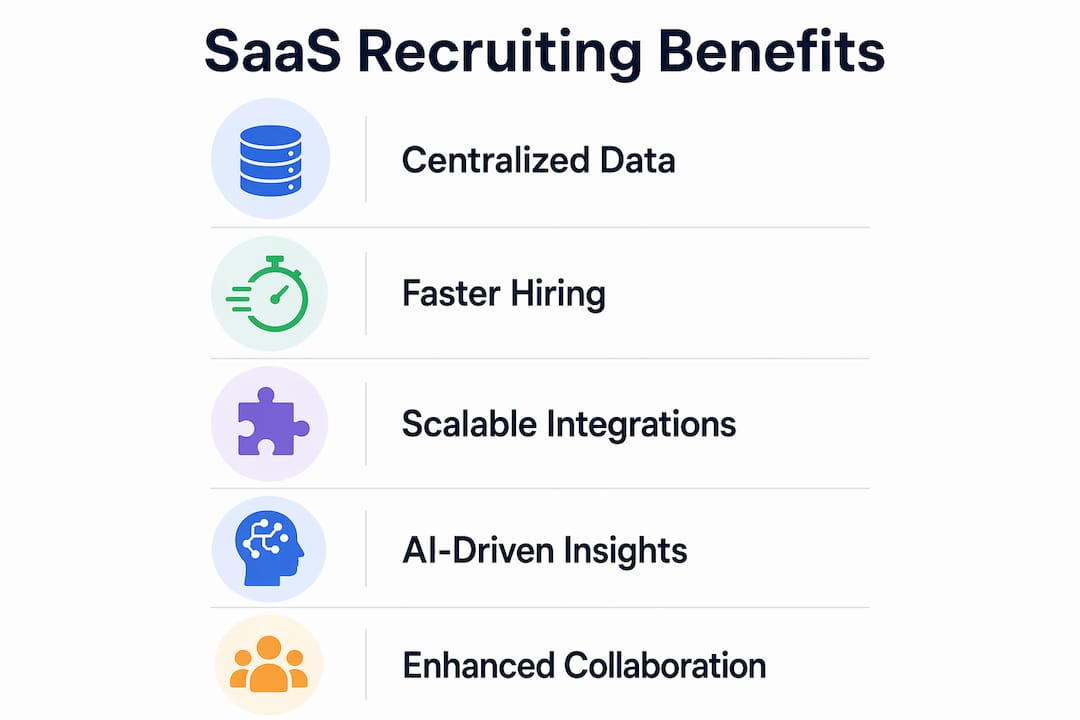
Centralizing recruitment data via SaaS reduces candidate loss caused by data fragmentation and slow response times. When a promising candidate applies and hears nothing for two weeks because their profile is buried in a shared inbox, they accept another offer. A centralized SaaS platform prevents that loss by keeping every stakeholder aligned in real time.
Pro Tip: When evaluating SaaS recruitment tools, check whether AI features are built natively into the workflow or added as a third-party plugin. Native AI outperforms bolt-on models in both accuracy and speed because it has access to the full data context of your hiring pipeline.
Why do integration and scalability matter for SaaS recruiting?
A SaaS recruiting platform is only as useful as its ability to connect with the tools your team already uses. For most organizations, that means Slack for communication, Notion or Confluence for documentation, and Linear or Jira for engineering workflows. API access and integration depth are critical for SaaS companies that need to avoid workflow silos. Without a well-documented public API, your ATS becomes an island.
Technical hiring adds another layer of complexity. Engineering roles make up 40–60% of SaaS headcount and consume roughly 80% of recruiter time. That concentration demands specialized ATS features: structured code review stages, multi-panel interview scheduling, and technical assessment integrations. A generic ATS built for retail hiring will not serve a software company filling ten senior engineering roles simultaneously.
Scalability matters just as much as integration. Hiring volume in SaaS companies shifts fast. A Series A startup might hire 5 people one quarter and 30 the next. A platform that requires vendor involvement to reconfigure workflows creates bottlenecks at exactly the wrong moment.
Here is what to verify before committing to any cloud-based recruitment platform:
- Public API availability. Confirm the API is documented, versioned, and accessible without a premium tier upgrade.
- Native integrations with your stack. Check for pre-built connectors to Slack, your HRIS, and your calendar tools.
- Technical hiring support. Look for structured interview kits, coding assessment integrations, and multi-stage pipeline configurability.
- Role-based permissions. Hiring managers, recruiters, and executives need different access levels without requiring IT involvement.
- Audit logs and compliance controls. Especially relevant if you operate across multiple jurisdictions with different data privacy requirements.
Legacy ATS platforms often fail on points 1 and 3. They were built before API-first design became standard, and retrofitting them is expensive and slow. Modern SaaS platforms build integration as a core feature, not an afterthought.
How does AI-driven data improve talent quality and hiring decisions?
AI changes what recruiters can actually evaluate. Traditional keyword filtering rewards candidates who know how to write resumes, not candidates who can do the job. Skills-based assessments and natural language processing scoring reveal candidate potential far more accurately than keyword filters. That shift matters because the best candidate for a role often does not use the exact terminology the job description was written with.
Predictive analytics take this further. Modern SaaS platforms score candidates not just on current skills but on indicators of retention likelihood, culture alignment, and growth trajectory. Recruiters who use these scores make faster decisions with higher confidence. The result is fewer mis-hires and lower cost-per-hire over time.
Data dashboards give HR leaders visibility they have never had before. You can track where candidates drop out of the funnel, which sourcing channels produce the highest-quality hires, and how long each stage takes. That visibility turns recruiting from a gut-feel activity into a measurable business function.
- Bias reduction. Structured scoring criteria applied consistently across all candidates reduces the influence of unconscious bias in early screening stages.
- Funnel analytics. Stage-by-stage conversion data shows exactly where your process loses strong candidates.
- Cost-per-hire tracking. Connecting sourcing channel data to hire outcomes reveals which investments actually pay off.
- Retention prediction. Some platforms score candidates on behavioral indicators correlated with long-term tenure.
Balancing automation with AI governance ensures hiring progresses transparently and minimizes bias. That balance is not optional. Regulators in the EU and several US states now require explainability in automated hiring decisions. Choosing a platform with built-in governance features protects your organization and builds candidate trust.
Pro Tip: Pair your SaaS ATS scoring with a personality-focused assessment layer. Skills can be learned; personality and working style are far more stable predictors of role fit. Sparkly’s approach of combining psychometric data, Human Design, and AI-computed insights gives you a much richer picture of a candidate than resume screening alone.
How does SaaS transform the recruiter’s role and team collaboration?
Agentic AI shifts recruiter focus from administrative tasks to strategic relationship building. That is the most underappreciated benefit of modern SaaS recruitment tools. When AI handles resume screening, interview scheduling, and follow-up reminders, recruiters get their time back. They use that time to build relationships with passive candidates, strengthen employer branding, and advise hiring managers on market realities.
Team collaboration improves dramatically when everyone works from the same platform. Hiring managers can leave structured feedback directly in the ATS instead of sending emails. Department heads can see pipeline status without asking for a report. Executives can track headcount progress against hiring plans in real time. That shared visibility reduces the friction that slows most hiring processes down.
Candidate experience also improves. Automated status updates, faster scheduling, and consistent communication make candidates feel respected. That matters because top candidates evaluate employers during the hiring process itself. A slow, disorganized process signals a slow, disorganized company.
- Warm talent pipelines. SaaS platforms let you tag and nurture candidates who were strong but not the right fit for a specific role, so you can re-engage them later.
- Asynchronous workflows. Distributed teams can review candidates and leave feedback without scheduling a synchronous meeting.
- Employer branding integration. Career page builders and automated candidate communications keep your brand consistent from first click to offer letter.
- Cross-department alignment. Shared dashboards mean finance, HR, and hiring managers all work from the same hiring data.
The role of technology in recruiting has moved well past automation. The best SaaS platforms now function as talent intelligence systems, connecting hiring data to workforce planning, team dynamics, and long-term retention outcomes.
Key Takeaways
SaaS recruitment platforms improve hiring speed, decision quality, and team alignment by centralizing data, applying AI-powered screening, and connecting with the tools organizations already use.
| Point | Details |
|---|---|
| Cloud adoption drives speed | 72% of organizations using cloud HR tech cut time-to-hire by 30–50%. |
| Native AI outperforms add-ons | AI built into the recruiting workflow produces faster, more accurate screening than bolt-on tools. |
| Integration prevents candidate loss | Centralizing data in one platform eliminates the fragmentation that causes slow responses and lost candidates. |
| Skills-based scoring beats keywords | NLP-driven assessments reveal candidate potential that keyword filters consistently miss. |
| Recruiters become strategic partners | When AI handles admin tasks, recruiters shift to relationship building and talent pipeline management. |
My take: SaaS is not a tool upgrade, it is a strategy upgrade
I have watched organizations spend months evaluating SaaS recruitment platforms and then implement them exactly like their old spreadsheet process. The technology changes but the thinking does not. That is the real barrier.
The companies getting the most out of cloud-based recruitment software are the ones that redesigned their hiring process around what the platform makes possible, not what they were already doing. They let AI handle the first filter. They built structured interview kits. They connected their ATS to their HRIS so that hiring data flows directly into onboarding and performance tracking.
What I find most exciting right now is the convergence of personality intelligence and SaaS recruiting. Skills-based hiring is a step forward from credential filtering, but it still misses something. Two candidates with identical skills will perform very differently depending on their personality, their working style, and the team they are joining. Sparkly’s approach of merging psychometric assessments, Human Design, and AI-computed insights addresses exactly that gap. It gives HR professionals data that a resume and a technical test simply cannot provide.
My recommendation: do not evaluate SaaS recruitment tools in isolation. Evaluate them as part of a connected talent architecture that includes assessment, onboarding, and team dynamics data. The role of AI in recruitment is not to replace human judgment. It is to give human judgment better inputs.
— Mikk
What Sparkly adds to your SaaS recruiting stack
Sparkly is a people-intelligence platform built for HR professionals who want more than a resume score. âš¡ï¸ It merges four data sources, including psychometric assessments, Human Design, AI analysis, and human observation, to compute insights about role fit, team dynamics, and hiring quality.
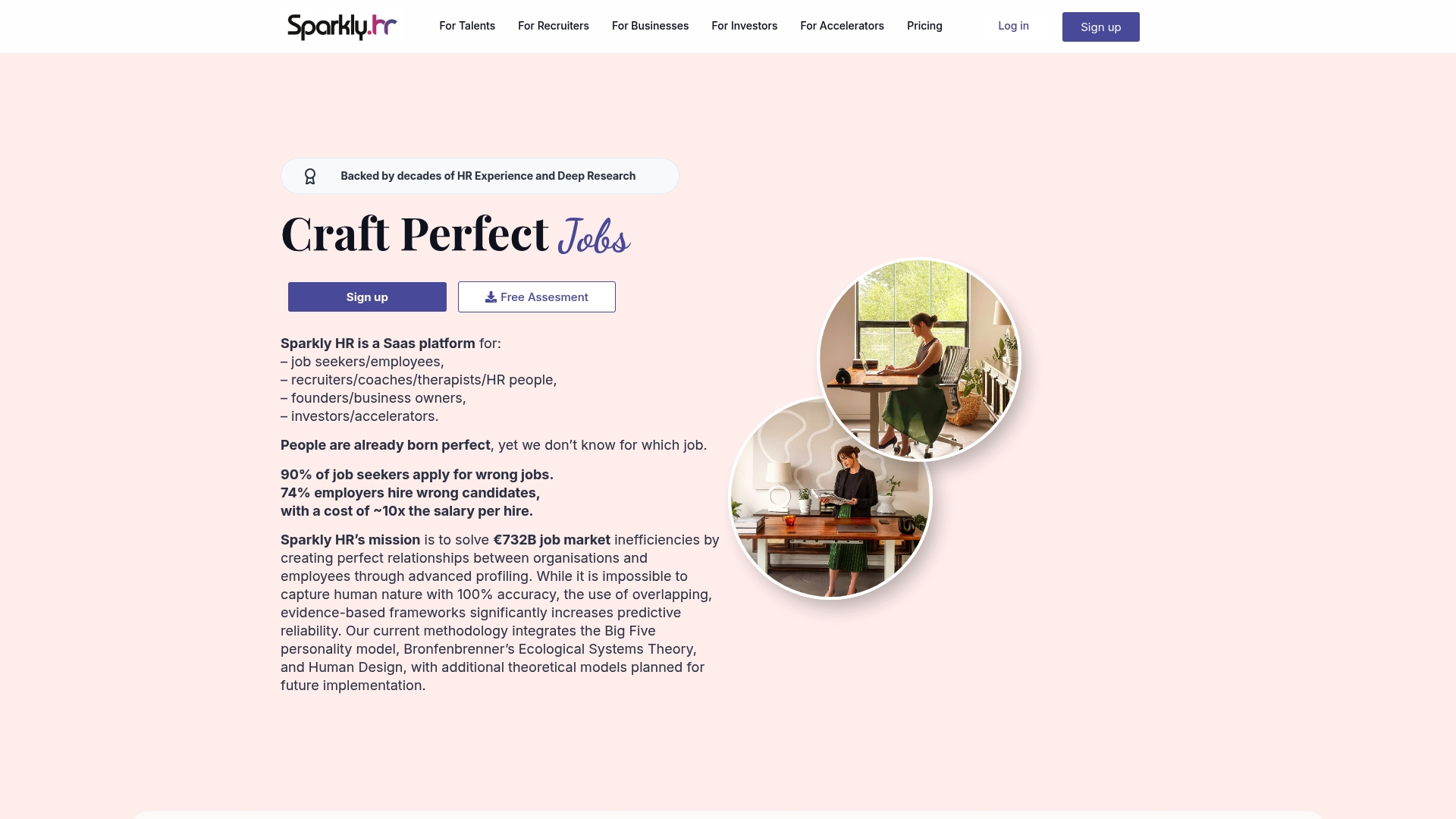
Where most SaaS recruitment tools stop at sourcing and screening, Sparkly goes deeper. It helps you understand whether a candidate’s personality and working style actually fit the role and the team they are joining. That distinction reduces mis-hires and cuts the turnover costs that follow them. Explore how SaaS transforms HR potential and see how Sparkly’s talent evaluation tools fit into your existing hiring workflow.
FAQ
What is the role of SaaS in modern recruiting?
SaaS recruitment platforms centralize candidate sourcing, screening, and workflow management in a cloud-hosted system. They reduce time-to-hire by automating repetitive tasks and giving all stakeholders real-time visibility into the hiring pipeline.
How does SaaS reduce time-to-hire?
Cloud-based recruitment software automates resume screening, interview scheduling, and candidate communications. Industry data shows organizations using these platforms cut time-to-hire by 30–50% compared to manual processes.
Why does API integration matter for SaaS recruiting platforms?
API access lets your ATS connect directly to tools like Slack, your HRIS, and engineering workflow platforms. Without it, teams manually reconcile data across systems, which slows hiring and increases the risk of losing candidates.
How does AI improve hiring decision quality?
AI-powered scoring uses skills-based criteria and natural language processing to evaluate candidates beyond keyword matching. This approach surfaces qualified candidates who would be filtered out by traditional resume screening.
What does Sparkly add that a standard ATS does not?
Sparkly assesses personality, working style, and team fit using psychometric data, Human Design, and AI-computed insights. Standard ATS platforms screen for skills and experience; Sparkly helps you predict how a person will actually perform and collaborate once hired.