The Role of AI in Assessment: HR Leaders’ 2026 Guide

TL;DR:
- AI enhances talent assessment by automating screening, predictive analytics, and adaptive testing to improve hiring accuracy.
- It reduces bias, accelerates processes, and enables continuous development but requires careful design and human oversight.
AI-powered assessment is defined as the use of machine learning, natural language processing, and predictive analytics to evaluate candidate and employee capabilities with greater speed and consistency than traditional methods allow. The role of AI in assessment has moved well past novelty. For HR professionals and business leaders, it now shapes hiring quality, turnover rates, and team performance in measurable ways. This guide breaks down how AI works in talent evaluation, what it genuinely improves, where it falls short, and how to build a practice that gets real results in 2026.
How AI technology is applied in employee assessment
AI transforms assessment by handling tasks that used to eat hours of HR time. Automated screening, adaptive testing, and predictive analytics are the three core applications reshaping how organizations evaluate people.

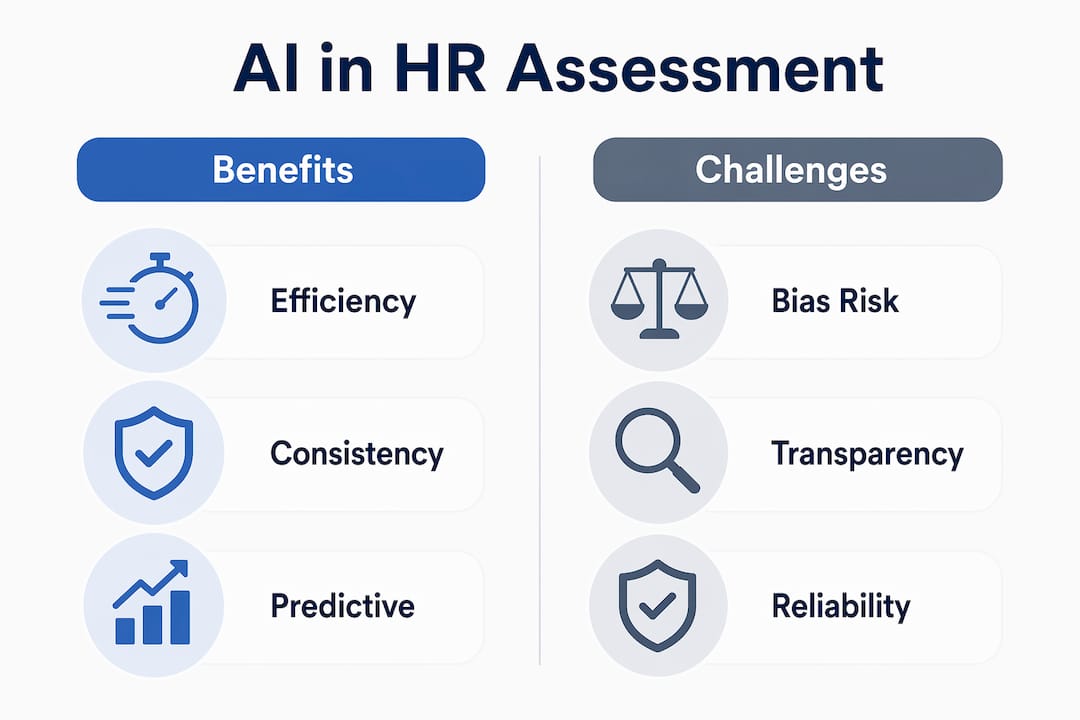
Automated screening and grading removes the bottleneck of reviewing hundreds of applications manually. AI models score responses, flag patterns, and rank candidates based on defined criteria. LLM-assisted question development is 5.6 times more efficient than traditional methods, cutting question creation time from 19.6 to 4.2 minutes per item. That kind of efficiency gain frees HR teams to focus on the conversations that actually matter.
Adaptive assessments adjust in real time based on how a candidate responds. If someone answers a complex question correctly, the next question gets harder. This approach produces a more accurate picture of capability in less time than a fixed test ever could. It also reduces the frustration candidates feel when a test is clearly too easy or impossibly hard.
Predictive analytics is where AI starts to earn its keep in hiring decisions. By analyzing patterns across thousands of past hires, AI models identify which personality traits, working styles, and cognitive signals correlate with strong performance and low turnover. This is the foundation of AI in recruitment as a genuine decision-support tool rather than a filter.
- Automated candidate screening based on structured criteria
- Adaptive question sequencing that adjusts to response quality
- Predictive fit scoring using historical performance data
- Natural language processing to analyze written and verbal responses
- Continuous assessment loops that track development over time
Pro Tip: Use AI-generated assessments for initial screening, but always pair them with a structured human interview before making a final hire. The AI narrows the field. The human makes the call.
What are the real benefits of AI in HR assessment?
The benefits of AI in testing and evaluation are not theoretical. They show up in hiring accuracy, cost reduction, and retention rates when implemented correctly.
-
Reduced unconscious bias. AI evaluates responses against defined criteria, not gut feeling. A well-designed model does not care about a candidate’s name, accent, or appearance. This does not eliminate bias entirely, since bias can enter through training data, but it removes many of the in-the-moment human biases that distort interviews.
-
Faster time-to-hire. Screening hundreds of candidates manually takes weeks. AI reduces that to hours. HR teams that cut turnover costs consistently point to faster, more accurate screening as the first lever they pulled.
-
Better predictive power for job fit. AI models trained on real performance data predict role fit more accurately than resume review alone. They surface candidates who look unconventional on paper but match the behavioral and cognitive profile of top performers.
-
Continuous employee development. AI does not stop at hiring. Embedded assessment tools track how employees grow, where they stall, and when they show signs of disengagement. This shifts assessment from a one-time event to an ongoing process.
-
Scalability without proportional cost. A human HR team can only review so many candidates per day. An AI system scales to thousands with no drop in consistency. For high-volume hiring, this is a structural advantage.
âš¡ï¸ Stat that matters: Grade inflation rises 30% in AI-exposed courses where assessment design has not adapted. This is a direct warning for HR leaders: AI improves assessment only when the assessment itself is redesigned around AI’s presence, not just automated on top of old frameworks.
The impact of AI on grading and evaluation quality is real, but it depends entirely on how the system is designed. AI amplifies good assessment design. It also amplifies bad design, faster.
What are the challenges of AI in assessment?
AI in evaluations carries genuine risks that HR leaders need to understand before they commit to any system.
The most significant risk is the false sense of competence problem. AI scaffolding can mask a lack of deep conceptual understanding, making candidates appear more capable than they are. In hiring, this means a candidate who performs well on an AI-assisted assessment may not actually possess the underlying skill the assessment was designed to measure. Process-based signals, such as how someone works through a problem, matter as much as the final answer.
A second challenge is qualitative nuance. AI-assisted grading struggles with partial credit decisions and context-dependent responses. A human evaluator recognizes when an unconventional answer reflects creative thinking. An AI model often does not. This is why the human-in-the-loop model is not optional. It is the difference between a useful tool and a liability.
- AI training data can encode historical biases, producing biased outputs
- Unsupervised take-home assessments are highly vulnerable to AI misuse, distorting competency measurement
- Candidates with limited AI literacy may be disadvantaged unfairly
- Lack of transparency in AI scoring erodes candidate trust
- Over-reliance on AI outputs reduces HR professionals’ own judgment over time
Pro Tip: Audit your AI assessment outputs quarterly. Compare AI scores against 90-day and 12-month performance reviews. If the correlation is weak, the model needs retraining or replacement.
Ethical use policies and transparency matter here. Candidates deserve to know when AI is evaluating them and what criteria it uses. Organizations that communicate this clearly build more trust and attract better candidates.
Best practices for implementing AI-driven assessments
Getting AI integration right requires structure. The table below maps the key implementation decisions to the outcomes they produce.
| Practice | What it does | Why it matters |
|---|---|---|
| Define assessment criteria before selecting AI tools | Keeps AI aligned to actual job requirements | Prevents the tool from driving the process instead of supporting it |
| Use human-in-the-loop review for all final decisions | Catches AI errors and qualitative gaps | No AI model fully replaces expert contextual judgment |
| Combine multiple data sources | Personality, cognitive, and behavioral data together | Single-source assessments miss critical dimensions of fit |
| Monitor model performance continuously | Track prediction accuracy against real outcomes | AI models drift as workforce and role requirements change |
| Train HR teams in AI literacy | Helps professionals interpret and challenge AI outputs | Prevents blind trust in scores that may be wrong |
The most effective approach combines AI efficiency with human judgment at every decision point. Experts advocate for continuous, embedded assessment that reveals how people think and grow, not just what they score on a single test. This is where the future of AI in assessments is heading: away from one-time events and toward ongoing insight.
Sparkly is built on exactly this principle. Rather than assessing skills alone, Sparkly merges psychometric data, Human Design, AI analysis, and human judgment to produce higher-probability insights about personality fit, role alignment, and team dynamics. Skills can be learned. Personality drives behavior. That distinction changes everything about how you hire and develop people. Explore personality-based assessment strategies to see how this works in practice.
HR leaders who want to go deeper on types of HR assessments that pair well with AI tools will find that combining personality, cognitive, and values assessments produces the most complete picture of a candidate.
Key Takeaways
AI improves assessment accuracy and efficiency when it combines automated screening, predictive analytics, and human oversight rather than replacing human judgment entirely.
| Point | Details |
|---|---|
| AI accelerates screening | LLM-assisted question creation is 5.6x faster than traditional methods, freeing HR time for higher-value work. |
| Human oversight is non-negotiable | AI struggles with qualitative nuance; a human-in-the-loop model protects fairness and validity. |
| False competence is a real risk | AI scaffolding can mask skill gaps, so process-based signals must supplement final scores. |
| Personality predicts more than skills | Assessing behavioral fit alongside cognitive data produces stronger retention and performance outcomes. |
| Continuous assessment beats one-time events | Embedded AI evaluation tracks growth and disengagement signals before they become costly exits. |
Why I think most companies are still using AI assessment backwards
Here is what I keep seeing: organizations buy an AI assessment tool, drop it on top of their existing hiring process, and expect better results. They get faster results. They do not necessarily get better ones.
The real opportunity is not automation. It is redesign. AI gives you the ability to assess dimensions of a person that a 45-minute interview never could. Collaboration style, resilience under pressure, curiosity, ethical reasoning. These are the signals that predict whether someone will still be thriving in the role two years from now. But you only capture them if you build your assessment around those questions from the start.
The other thing I have learned: the organizations that get the most from AI assessment are the ones that invest in their HR team’s ability to interpret and challenge the outputs. An AI score is a hypothesis, not a verdict. The best HR professionals treat it that way. They ask why the model scored someone low, look at the underlying signals, and sometimes override the recommendation with good reason.
The future of AI in assessments belongs to leaders who treat it as a thinking partner, not an answer machine. That mindset shift is harder than buying the software. It is also the only thing that makes the software worth buying.
— Mikk
Sparkly’s approach to AI-powered talent assessment
Hiring decisions made on incomplete data are expensive. The average cost of a bad hire runs well into the tens of thousands of dollars when you factor in lost productivity, team disruption, and rehiring costs.
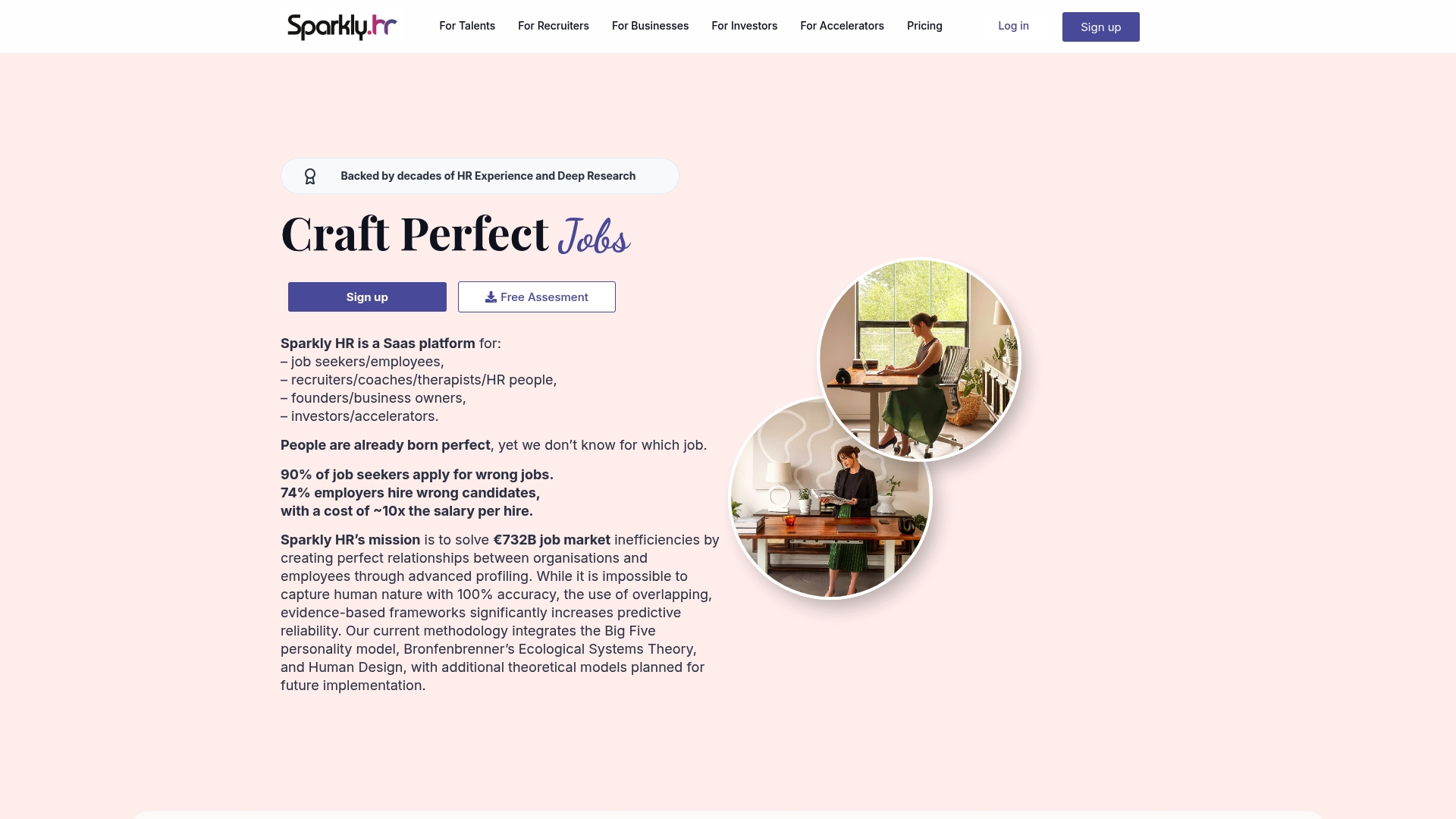
Sparkly combines AI analysis, psychometric assessments, Human Design, and human judgment into a single decision-support platform built for HR leaders who want to hire right the first time. The platform focuses on personality fit over skills because skills can be taught. Personality drives how someone shows up every day. If you are serious about reducing mismatch and cutting turnover, explore Sparkly’s SaaS approach to talent assessment. For a practical starting point, the employee fit assessment guide walks through exactly how to apply these principles to your hiring process in 2026.
FAQ
What is the role of AI in assessment?
The role of AI in assessment is to automate screening, improve scoring consistency, and generate predictive insights about candidate fit and performance. AI works best as a decision-support tool paired with human judgment, not as a standalone evaluator.
How does AI reduce bias in hiring assessments?
AI reduces bias by evaluating candidates against defined, consistent criteria rather than subjective impressions. However, bias can still enter through flawed training data, so regular audits of AI outputs are necessary to maintain fairness.
What are the biggest risks of AI in employee evaluation?
The biggest risks are false competence perception, where AI scaffolding masks real skill gaps, and over-reliance on scores that lack contextual nuance. Human oversight at every final decision point is the most effective mitigation.
How does AI improve assessment efficiency?
AI reduces question creation time from 19.6 to 4.2 minutes per item and screens large candidate pools in hours rather than weeks. That efficiency gain lets HR teams concentrate on the human interactions that determine final hiring decisions.
What is the future of AI in assessments for HR?
The future of AI in assessments moves toward continuous, embedded evaluation that tracks personality fit, growth signals, and burnout risk over time. Static, one-time testing is being replaced by ongoing insight that helps organizations develop and retain the people they already have.