
Step by Step Hiring Assessment: A Guide for HR Teams

TL;DR:
- A step-by-step hiring assessment uses multiple stages with predefined thresholds to improve hiring accuracy. Structured processes with anchored rating scales and regular reviews reduce bias and increase the likelihood of selecting successful candidates. Tracking post-hire performance ensures the assessment remains effective in predicting long-term success.
A step by step hiring assessment is a systematic, multi-stage evaluation process that moves candidates through defined checkpoints, each with scoring thresholds, before advancing them to the next round. The industry term for this approach is a “multi-hurdle assessment framework,†and it is the gold standard in structured recruitment evaluation. Companies with structured hiring processes reduce time-to-hire by 33% and double first-year retention rates. That is not a marginal improvement. It is the difference between a team that performs and one that churns. This guide walks you through every stage, the tools you need, and the mistakes that quietly destroy hiring quality.
What does a step by step hiring assessment actually require?
Before you run a single interview, you need a foundation. Skipping this step is the most common reason structured hiring falls apart in practice.
Start with job analysis and competency definition. A job analysis identifies the specific tasks, decisions, and behaviors the role demands on a daily basis. From that analysis, you extract three to five core competencies. These become the backbone of every assessment stage. Not all competencies carry equal weight, and weighting competencies by importance improves overall assessment accuracy and hiring decisions. A sales role might weight “persuasion under pressure†at 40% and “data literacy†at 20%. That weighting changes who passes.
Match assessment types to funnel stages. The type of test you use matters as much as when you use it. Skills and cognitive tests work best early in the funnel, while personality assessments are better suited as post-interview tools that inform panel discussions. Placing a personality test at the top of the funnel filters candidates on traits that are not yet relevant and loses qualified people prematurely. Use cognitive and skills tests to narrow the field, then use personality data to deepen your understanding of finalists.
Build anchored rating scales before interviews begin. An anchored rating scale defines what a “weak,†“solid,†and “strong†answer looks like for each competency. Anchored rating scales are the most important element of effective structured interviews because they reduce bias and promote consistency across interviewers. Without them, two interviewers evaluating the same candidate will score differently based on personal preference, not evidence.
Pro Tip: Build your scoring rubric before you post the job, not after you receive applications. Rubrics created under time pressure tend to reflect the first strong candidate you saw, not the actual role requirements.
The tools you need at this stage include an applicant tracking system (ATS) to manage candidate flow, a competency library or job analysis framework, and a shared scoring document accessible to all interviewers. Platforms that support structured recruitment planning integrate these elements into a single workflow, which reduces coordination errors significantly.
How to execute each stage of the assessment process
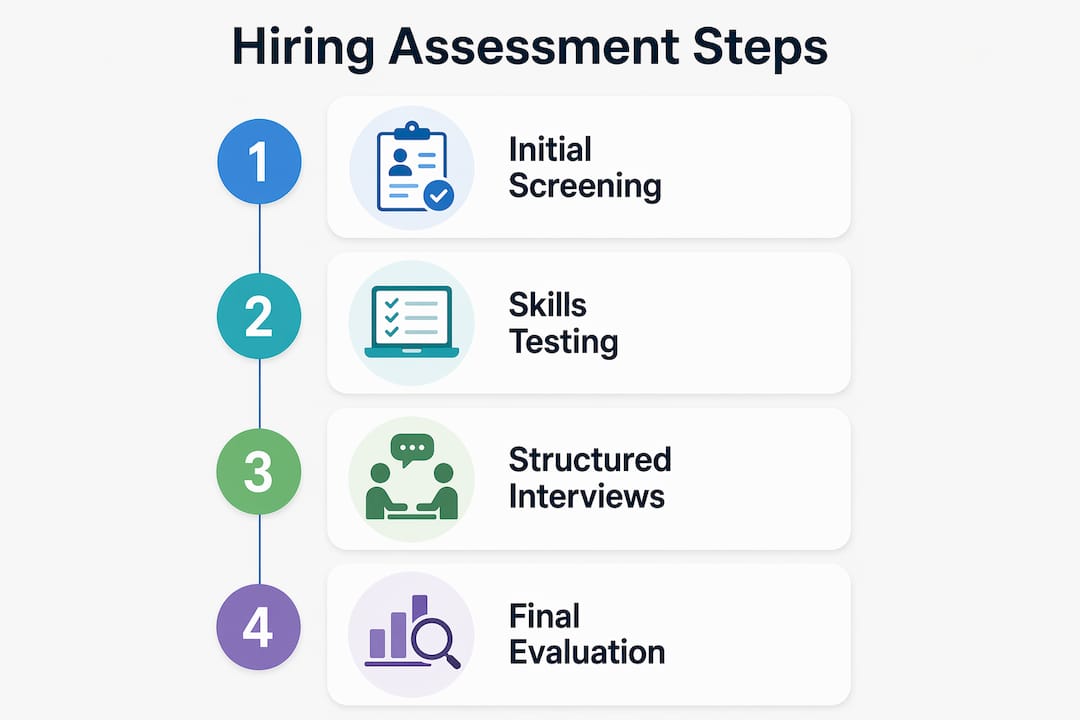
A well-run multi-hurdle assessment moves candidates through four sequential stages. Each stage has a clear purpose, a defined scoring threshold, and a decision gate.
Stage 1: Initial screening. Review applications against a short checklist of non-negotiable criteria. These are binary: the candidate either meets them or does not. Keep this list to three to five items. Anything beyond that introduces subjectivity at a stage that should be purely mechanical.
Stage 2: Cognitive and skills assessment. Send candidates a timed cognitive test or a skills task relevant to the role. Work samples and take-home tasks should stay under 2–4 hours, with fair compensation when possible. Candidates who exceed a defined score threshold advance. Those who do not are declined at this stage with a clear, respectful communication.

Stage 3: Structured interviews. Every candidate receives the same questions in the same order. Interviewers score each answer immediately using the anchored rating scale. Predetermined follow-up probes tailored to each question standardize evaluation depth and reduce bias better than generic prompts like “Can you elaborate?†Write two to three scripted follow-up questions per competency before the interview begins.
Stage 4: Final evaluation and panel debrief. Compile scores across all interviewers. Calculate a weighted total using your competency weights. Hold a structured debrief where interviewers share scores before discussing impressions. This order matters. Sharing scores first prevents the loudest voice in the room from anchoring everyone else’s judgment.
| Stage | Primary tool | Decision criteria |
|---|---|---|
| Initial screening | Application checklist | Pass/fail on non-negotiables |
| Skills and cognitive testing | Timed assessment or work sample | Score above defined threshold |
| Structured interview | Anchored rating scale | Weighted competency score |
| Panel debrief | Scoring summary | Consensus on total weighted score |
Pro Tip: Send candidates a one-page brief before each stage explaining what to expect, how long it takes, and how they will be evaluated. Candidates who feel respected perform more authentically, and you get cleaner data.
Multi-hurdle assessments require candidates to meet thresholds at sequential stages, including screening, skills testing, and final interviews. This structure prevents strong performers at one stage from masking weaknesses at another. A candidate who aces the interview but scores poorly on the cognitive test is not a strong hire. The data tells you that before you make an offer.
What mistakes undermine hiring assessments most often?
Most hiring processes fail not because the tools are wrong, but because execution breaks down in predictable ways. Knowing where the cracks appear lets you seal them before they cost you a hire.
- Ambiguous rubrics. A rubric that says “demonstrates leadership†without defining what that looks like in a 1-to-5 answer is not a rubric. It is a blank canvas for bias. Every anchor point needs a behavioral example.
- Skipping validity checks. Many organizations skip ongoing validity checks linking assessments to job performance, which weakens hiring quality over time. If your cognitive test does not correlate with 90-day performance, it is measuring the wrong thing.
- Unscripted follow-up probes. Interviewers who improvise follow-up questions introduce inconsistency. One candidate gets a clarifying question that helps them recover a weak answer. Another does not. That is not assessment. That is luck.
- Assessments that are too long. Candidate drop-off increases sharply when assessments exceed four hours. A process that loses your best candidates before they reach the interview stage is filtering for availability, not ability.
- No calibration sessions. Interviewers who have never discussed what a “4 out of 5†looks like will score differently. Run a calibration session before the first interview cycle using sample answers. Thirty minutes of calibration saves weeks of bad decisions.
“The biggest hidden cost in hiring is not a bad hire. It is the good candidate who dropped out because your process felt disorganized, disrespectful, or unclear. Assessment rigor and candidate experience are not in conflict. A well-structured process signals that you run a well-structured organization.â€
Periodic review of your assessment components is not optional. Structured hiring workflows can cut time-to-hire by up to 60%, but only when the process is actively maintained. Review your rubrics every six months. Retire questions that no longer reflect the role. Add new competencies when the job evolves.
How do you measure whether your hiring assessment is working?
An assessment process that no one measures is a process that drifts. The most reliable way to know if your hiring assessment works is to track what happens after the hire.
Quarterly correlation of assessment scores with manager performance ratings is the critical validity check that most teams skip. Pull your 90-day performance data for every new hire. Compare it to their assessment scores by stage. If candidates who scored high on your cognitive test consistently outperform those who scored lower, the test is valid. If there is no correlation, the test is measuring something irrelevant to the role.
Pro Tip: Build a simple dashboard that tracks three numbers: average assessment score at hire, 90-day performance rating, and 12-month retention. Update it quarterly. Those three numbers will tell you more about your hiring quality than any post-mortem conversation.
Use feedback loops at every stage. Ask candidates who declined your offer why they dropped out. Ask hiring managers what they wish they had known about a new hire before the offer. Ask new employees at 30 days what surprised them about the role. Each of these inputs reveals a gap between what your assessment measured and what the job actually requires.
| Metric | What it tells you |
|---|---|
| Assessment score vs. 90-day performance | Whether your tests predict real job success |
| Stage drop-off rate | Where candidates disengage or self-select out |
| Time-to-hire by stage | Where delays concentrate in the process |
| Offer acceptance rate | Whether candidate experience is competitive |
The role of assessments in hiring extends beyond selection. When you track post-hire performance against assessment data, you build an evidence base that lets you improve every future hiring cycle. That compounding effect is what separates organizations with consistently strong teams from those that rehire the same roles every 18 months.
Key Takeaways
A structured, multi-hurdle hiring assessment built on anchored rating scales, competency weighting, and quarterly validity checks is the most reliable way to improve hiring quality and reduce early turnover.
| Point | Details |
|---|---|
| Build rubrics before posting | Define anchored rating scales for each competency before the first application arrives. |
| Match tests to funnel stages | Use cognitive and skills tests early; reserve personality assessments for post-interview panel discussions. |
| Script follow-up probes | Pre-write two to three follow-up questions per competency to standardize evaluation depth. |
| Track validity quarterly | Correlate assessment scores with 90-day performance ratings to confirm your tests predict success. |
| Review and update regularly | Audit rubrics and questions every six months to keep assessments aligned with evolving role requirements. |
Why I think most hiring assessments fail before the first interview
After working with hiring teams across industries, the pattern is consistent. Organizations invest in assessment tools and then underinvest in the process that makes those tools work. They buy a personality test and use it as a filter at the top of the funnel, which is exactly the wrong stage. They build a rubric once and never revisit it. They run calibration sessions once and assume interviewers stay calibrated forever.
The deeper issue is that most hiring managers treat assessment as a compliance step, not a decision-making tool. They go through the motions because HR requires it, then make the actual decision based on gut feeling in the final debrief. The anchored scale sits unused. The weighted scores get ignored. The hire goes to the person who “felt right.â€
What actually works is treating the assessment data as the primary input and the gut feeling as a secondary check, not the other way around. When I see teams make that shift, hiring quality improves noticeably. Turnover drops. Onboarding gets faster because the role fit was real, not assumed. The candidate potential assessment becomes a genuine predictor rather than a formality.
The other thing most articles will not tell you: candidate experience and assessment rigor reinforce each other. A candidate who goes through a clear, well-structured process arrives on day one with accurate expectations. That alignment reduces early exits more than almost any onboarding program. Build the process well, communicate it clearly, and the assessment does double duty as both a selection tool and a retention signal.
— Mikk
How Sparkly supports structured hiring with personality-first insights
Structured hiring gets significantly sharper when the data behind it goes deeper than skills and cognitive scores.
Sparkly is built for exactly this moment in the hiring process. It combines psychometric assessments, AI analysis, Human Design, and human judgment into a single computed insight about role fit, personality, and working style. That means your panel debrief is informed by data that no single interviewer could surface alone. Sparkly’s personality-focused assessment approach helps hiring managers move beyond gut feeling and into evidence-based decisions at every stage of the funnel. For teams ready to build a hiring process that actually predicts performance, Sparkly is the place to start.
FAQ
What is a multi-hurdle hiring assessment?
A multi-hurdle assessment requires candidates to meet a defined score threshold at each sequential stage before advancing. Common stages include initial screening, cognitive or skills testing, and structured interviews.
When should personality tests be used in the hiring process?
Personality tests are most effective as post-interview tools that inform panel discussions, not as early-stage filters. Using them too early can eliminate qualified candidates before their relevant strengths are visible.
How do anchored rating scales reduce bias in interviews?
Anchored rating scales define what a weak, solid, and strong answer looks like for each competency. This shared definition keeps all interviewers scoring against the same standard rather than personal preference.
How often should you review your hiring assessment process?
Review rubrics, questions, and competency weights every six months. Also run quarterly correlations between assessment scores and 90-day performance ratings to confirm your tools still predict success.
What is the fastest way to improve hiring assessment quality?
Run a calibration session with all interviewers before the first hiring cycle begins. Thirty minutes of alignment on scoring standards reduces inconsistency more than any single tool or process change.