Recruitment Bias Reduction Guide for HR Leaders

TL;DR:
- Recruitment bias reduction uses evidence-based processes to eliminate unfair prejudices from hiring. Implementing structured interviews, blind screening, and diverse panels helps organizations improve fairness and legal compliance. Emphasizing culture add over culture fit drives diversity and enhances business performance.
Recruitment bias reduction is the practice of applying structured, evidence-based methods to remove unfair prejudices from hiring decisions. Without it, companies lose qualified candidates, face legal exposure, and build teams that think alike rather than perform well. The EEOC reported 88,531 discrimination charges in FY 2024, a 9.2% increase year over year. That number signals a real and growing compliance risk for any organization that has not yet built a formal recruitment bias reduction guide into its hiring process. Tools like structured interviews, blind resume screening, and personality-based assessment platforms such as Sparkly are now the baseline for HR teams serious about fair, high-quality hiring.
Where does bias enter the recruitment process?
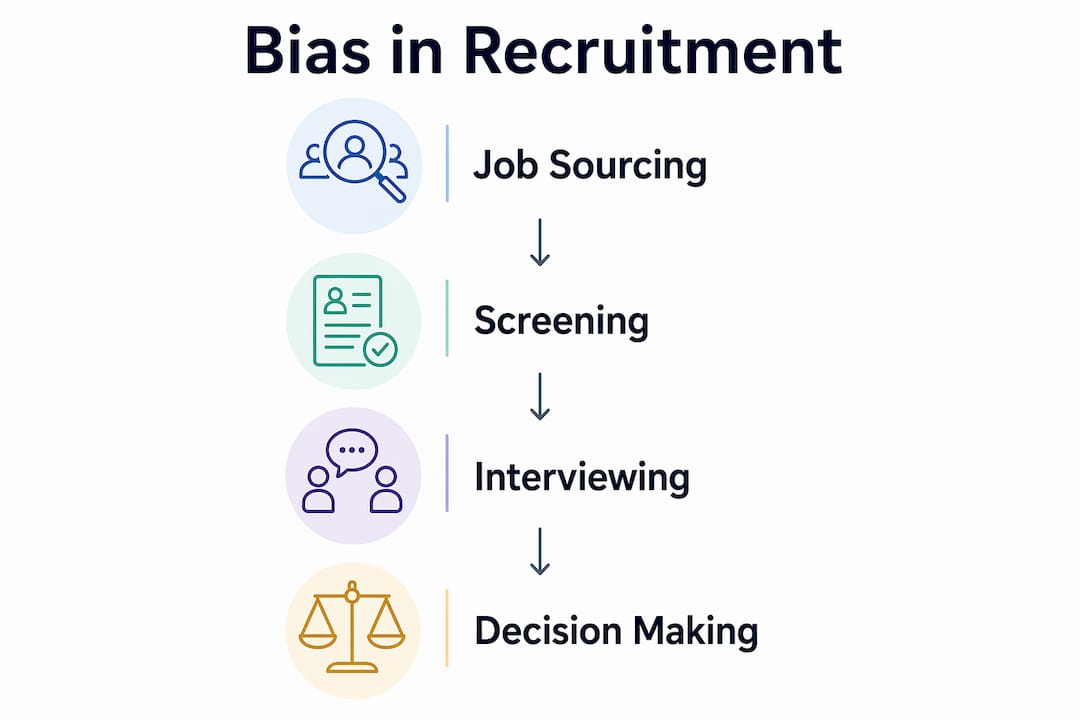
Bias does not arrive at one moment. It seeps in at every stage of the hiring funnel, often without anyone noticing.
Sourcing and job descriptions are the first vulnerability. When job postings include vague “culture fit†language or long lists of preferred qualifications, they signal who is and is not welcome before a single application arrives. Research from the University of Wisconsin-Madison confirms that removing “nice-to-have†criteria from job descriptions broadens applicant pools and reduces the risk of excluding diverse candidates early.
Resume screening is where bias accelerates. Recruiters make fast judgments based on names, schools, and address details that have nothing to do with job performance. These snap decisions reflect affinity bias (favoring candidates who feel familiar), halo effect (letting one impressive credential overshadow everything else), and confirmation bias (seeking evidence that supports a first impression).
Interviewing is the stage most HR teams believe is fair. It rarely is. Unstructured interviews are essentially conversations, and conversations favor candidates who share the interviewer’s background, communication style, or social references. Common bias types at this stage include:
- Affinity bias: Preferring candidates who remind interviewers of themselves
- Confirmation bias: Asking questions designed to confirm an early impression
- Halo and horn effects: Letting one strong or weak signal color the entire evaluation
- Attribution bias: Crediting success to personality for some candidates and luck for others
- Contrast effect: Rating a candidate higher or lower based on who was interviewed just before them
Decision-making is the final risk point. When hiring managers discuss candidates informally, group dynamics push toward consensus around the most familiar choice. Without a scoring rubric, the loudest voice in the room often wins.
The legal stakes are real. The 9.2% rise in EEOC charges in 2024 shows that regulators and candidates are paying closer attention. HR leaders who cannot demonstrate a structured, documented process face both reputational and financial consequences.
Proven strategies for reducing bias in recruitment
The most effective bias-free recruitment techniques share one trait: they replace subjective judgment with consistent, documented process. Here are the methods with the strongest evidence behind them.
-
Use structured interviews with standardized scoring. Structured interviews reduce hiring bias by up to 40% and improve hire quality by focusing on demonstrated competence rather than likeability. Every candidate answers the same questions in the same order, and every answer is scored against a defined rubric before the next interview begins.
-
Apply blind resume screening. GOV.UK research confirms that anonymized applications improve gender diversity and reduce affinity bias at the CV screening stage. Remove names, photos, addresses, and graduation years before resumes reach reviewers.
-
Write tighter job descriptions. Focus on Day 1 must-have qualifications only. Trimming requirements to essentials opens doors to qualified candidates who would otherwise self-exclude based on a list they cannot fully match.
-
Build diverse hiring panels. A panel with varied backgrounds, genders, and functions catches blind spots that a single interviewer misses. Rotate panel members across roles to prevent any one person from becoming the default decision-maker.
-
Add work sample tests. Combining structured interviews with work sample tests can raise predictive hiring validity to approximately 0.63, a significant improvement over unstructured interviews alone. Candidates demonstrate actual job-relevant skills rather than describing them.
-
Run regular bias awareness training. Training alone does not eliminate bias, but it raises awareness of specific patterns like the contrast effect and attribution bias. Pair training with process changes so awareness translates into different behavior.
Pro Tip: Replace “culture fit†with “culture add†as an evaluation criterion. Culture fit rewards similarity. Culture add asks what unique perspective this person brings to the team, which directly supports diversity in hiring strategies.
Treating every candidate identically in process and evaluation is the foundation of fair hiring. Consistency is not just ethical. It is the mechanism that makes all other interventions work.

How should you use AI and technology in bias reduction?
AI tools can speed up screening, flag language bias in job postings, and surface candidates who might be overlooked. Used well, they support inclusive hiring practices. Used carelessly, they replicate the exact biases they were meant to fix.
The core risk is straightforward. AI models trained on historical hiring data learn from past decisions, including past biased decisions. An algorithm that learned from a company’s last ten years of hires will reproduce the demographic patterns of those hires unless the training data is actively corrected.
Key principles for responsible AI use in hiring:
- Audit AI models regularly. Automated systems must be audited for algorithmic discrimination before deployment and on a scheduled basis afterward. Bias can enter through proxy variables like zip code or university name even when protected characteristics are excluded.
- Apply human review to all automated rejections. AI governance controls must include mandatory human oversight of any automated reject decision. No candidate should be eliminated from a process by an algorithm alone.
- Use AI for defined, auditable tasks. Automated screening for minimum qualifications, scheduling, and language analysis in job descriptions are legitimate applications. Subjective assessments of personality or culture fit are not.
- Combine AI efficiency with human judgment. Effective bias mitigation combines technology with structured processes and human judgment to balance speed with fairness.
“Technology does not make hiring fair. Process makes hiring fair. Technology makes fair processes faster.â€
For HR leaders evaluating AI tools, the right question is not “Does this tool reduce bias?†but “Can we audit exactly how this tool makes decisions?†If the vendor cannot answer that question clearly, the tool is a liability. You can explore how AI shapes talent fit in practice before committing to any platform.
How do you build a sustainable bias-reduction program?
A single training session or a one-time process audit does not constitute a bias-reduction program. Bias reduction is a continuous workflow discipline, not a project with an end date. The organizations that sustain progress are the ones that treat fairness as a measurable operational metric.
Start by setting specific KPIs. Track application-to-interview conversion rates by demographic group, offer acceptance rates, and first-year retention by hire cohort. These numbers tell you whether your process is producing equitable outcomes or just equitable intentions.
Pro Tip: Assign a named owner to each fairness metric. When no one is accountable for a number, the number does not move. Ownership turns measurement into action.
Quarterly reviews of fairness metrics are the minimum standard for sustained improvement. Review the data, identify where drop-off rates diverge across groups, and adjust the process before the next hiring cycle begins. Build feedback loops so hiring managers can flag process friction and candidates can report concerns.
| Point | Details |
|---|---|
| Structured interviews | Standardize questions and scoring rubrics before each hiring cycle begins. |
| Blind screening | Remove identifying information from resumes before they reach reviewers. |
| Diverse panels | Rotate panel members to prevent single-person dominance in decisions. |
| Fairness KPIs | Track conversion and retention rates by demographic group every quarter. |
| Culture add criteria | Evaluate what unique perspective a candidate brings, not how familiar they feel. |
Replace “culture fit†with culture add evaluation across all assessment rubrics. Culture add expands team capabilities by valuing unique perspectives and lived experience. Culture fit creates homogeneity traps that compound over time and directly undermine diversity in hiring strategies.
The business case is clear. Inclusive hiring practices can boost innovation revenue by 19% and reduce employee turnover by up to 50%. Companies that implement inclusive hiring report a 36% higher rate of outperforming competitors. These are not soft benefits. They show up in revenue, retention, and competitive position.
Key Takeaways
Reducing recruitment bias requires consistent process, regular measurement, and a shift from culture fit to culture add at every stage of the hiring funnel.
| Point | Details |
|---|---|
| Bias enters at every stage | Sourcing, screening, interviewing, and decisions all carry distinct bias risks. |
| Structured interviews work | Standardized questions and scoring reduce bias by up to 40% and improve hire quality. |
| AI needs human oversight | Automated tools must be audited regularly and never make final reject decisions alone. |
| Measure fairness quarterly | Track conversion and retention metrics by demographic group to detect and fix drift. |
| Culture add beats culture fit | Evaluating what candidates contribute, not how familiar they feel, builds stronger teams. |
Why I think most bias-reduction efforts stall before they stick
Most organizations treat bias reduction as a compliance exercise. They run a workshop, update the job description template, and call it done. Six months later, the same hiring patterns reappear because the process was never actually changed, only documented.
What I have seen work is treating bias reduction the way you treat financial controls. You do not audit your books once and assume they stay accurate. You build recurring checks into the workflow. The same logic applies here. Quarterly fairness metric reviews, rotating interview panels, and mandatory scoring rubrics are not bureaucracy. They are the mechanism that keeps good intentions from fading under hiring pressure.
The technology question is where I see the most overconfidence. HR teams adopt AI screening tools and assume the bias problem is solved. It is not. An AI trained on your last five years of hires learned from every biased decision in that period. Without active auditing and human review of automated rejections, you are scaling the problem, not fixing it.
The shift I find most underused is moving from culture fit to culture add as a formal evaluation criterion. Culture fit is a feeling. Culture add is a question: what does this person bring that we do not already have? That question produces better teams and better business outcomes. It also happens to be one of the most practical diversity in hiring strategies available, and it costs nothing to implement.
Bias reduction is not a destination. It is a discipline. The teams that build it into their quarterly rhythm are the ones still making progress two years from now.
— Mikk
How Sparkly supports fair, personality-driven hiring
Sparkly is built for HR teams that want to go beyond CVs and gut feeling. The platform merges psychometric assessments, personality profiling, and Human Design data to generate computed insights about role fit, team dynamics, and hiring quality. That combination gives interviewers structured, evidence-based talking points rather than impressions. âš¡ï¸
Where most hiring tools assess skills, Sparkly assesses personality first, because skills can be learned and personality drives long-term fit. For HR leaders building a bias-reduction program, Sparkly’s structured evaluation framework replaces subjective judgment with consistent, documented data. Explore how SaaS transforms hiring decisions and see whether Sparkly fits your team’s next hiring cycle. You can also review the top talent evaluation tools ranked for HR professionals in 2026.
FAQ
What is recruitment bias reduction?
Recruitment bias reduction is the practice of applying structured processes, such as blind screening and standardized interviews, to remove unfair prejudices from hiring decisions. The goal is to evaluate candidates on job-relevant criteria only.
How do structured interviews reduce hiring bias?
Structured interviews reduce bias by requiring every candidate to answer the same questions in the same order, scored against a defined rubric. This approach reduces hiring bias by up to 40% compared to unstructured conversations.
Can AI tools eliminate bias in hiring?
AI tools can reduce certain bias types but also replicate historical bias if trained on biased data. Human review of all automated reject decisions is mandatory to prevent algorithmic discrimination.
How do you measure bias reduction success?
Track application-to-interview conversion rates, offer acceptance rates, and first-year retention by demographic group. Reviewing these fairness metrics quarterly is the minimum standard for sustained improvement.
What is the difference between culture fit and culture add?
Culture fit favors candidates who resemble existing employees, which reinforces homogeneity. Culture add evaluates what unique perspective a candidate brings to the team, directly supporting diversity and stronger performance.