Recruiter Bias Explained: A 2026 Guide for HR Teams

TL;DR:
- Recruiter bias influences hiring decisions unrelated to candidate ability, leading to unfair and costly outcomes. Implementing structured interviews, blind screening, and diverse panels can reduce bias and improve hiring quality and diversity. AI’s impact depends on how it is used, requiring careful auditing and combined human oversight to prevent discrimination.
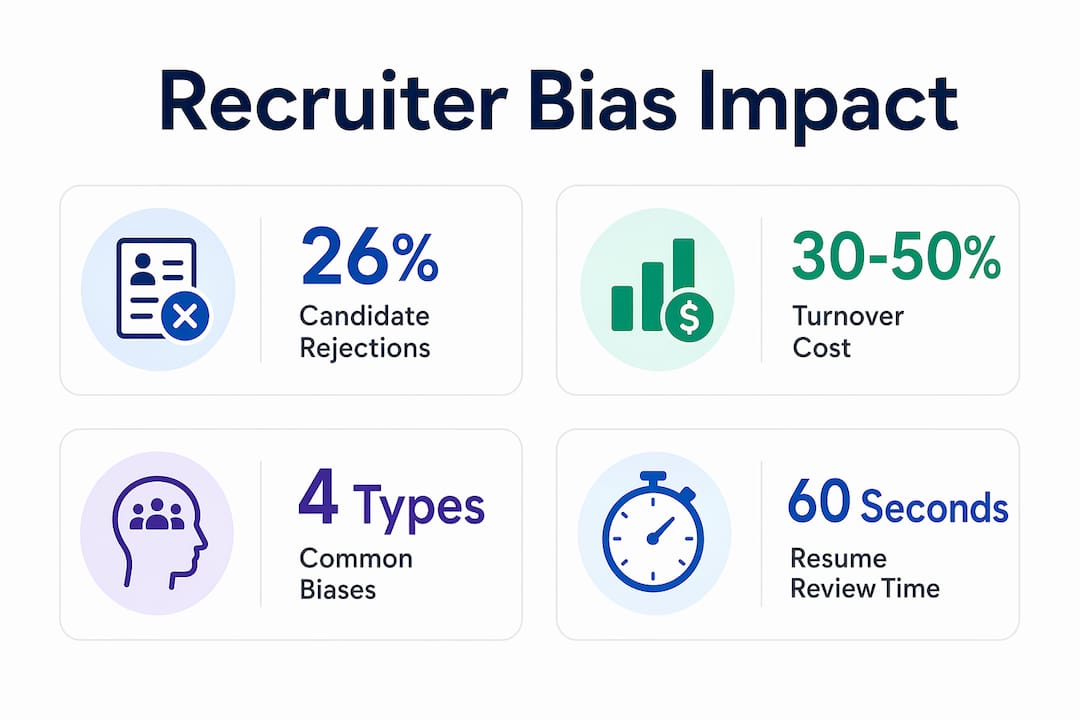
Recruiter bias is any influence on a hiring decision that is unrelated to a candidate’s ability to do the job, producing unfair and suboptimal selection outcomes. The industry term for this phenomenon is employment selection bias, and it operates at every stage of the hiring funnel, from resume screening to final offer. Bad hires linked to bias cost organizations between 30% and 50% of the employee’s first-year salary. That figure reframes bias as a financial risk, not just an ethical concern. HR professionals who treat it as a compliance checkbox are leaving real money and talent on the table.
What is recruiter bias, and why does it distort hiring?
Recruiter bias is a systematic distortion in hiring decisions that causes evaluators to favor or reject candidates based on criteria irrelevant to job performance. It operates through both conscious prejudice and unconscious mental shortcuts called cognitive heuristics. The result is the same either way: the best candidate does not always get the role.

The bias enters the process at every touchpoint. A recruiter skims a resume in six seconds and forms a first impression. An interviewer warms to a candidate who shares their alma mater. A hiring panel scores a candidate higher because one vocal member liked them. None of these reactions measure job performance. All of them influence the final decision.
What makes selection bias particularly costly is that it compounds. A biased screen produces a biased shortlist. A biased shortlist produces a biased interview pool. By the time an offer goes out, the distortion has been reinforced at three or four separate stages. Structured recruitment planning is one of the few reliable ways to interrupt that chain before it completes.
What are the common types of recruiter bias?
Four bias types appear most frequently in hiring processes, and each one operates differently.
- Affinity bias causes recruiters to favor candidates who share their background, interests, or communication style. A recruiter who played college sports may unconsciously score an athlete higher on “team fit†without any evidence of collaboration skills.
- The halo effect occurs when one strong positive trait, such as an impressive employer name on a resume, inflates scores across all other evaluation criteria. The candidate seems better at everything because they seem better at one thing.
- Confirmation bias drives interviewers to seek evidence that confirms their first impression rather than test it. If a recruiter decides in the first two minutes that a candidate is a strong fit, subsequent questions tend to invite agreement rather than challenge.
- Algorithmic bias is the newest and least visible form. AI screening tools trained on historical hiring data replicate the patterns of whoever made those past decisions. If past hires skewed toward one demographic, the algorithm learns to prefer that demographic.
Each of these biases affects a different stage of the funnel. Affinity bias and the halo effect hit hardest at resume review and initial screening. Confirmation bias dominates unstructured interviews. Algorithmic bias can corrupt the entire process before a human ever sees a candidate’s name.
Pro Tip: Replace the phrase “culture fit†in your scoring rubrics with specific, observable behaviors. “Communicates clearly under pressure†is measurable. “Fits our culture†is a bias invitation.
How does recruiter bias impact diversity and hiring quality?
The measurable consequences of selection bias on talent pipelines are significant. AI screening algorithms reject 26% of Black applicants and 15% of Asian applicants at rates higher than comparable white candidates, affecting roughly 40,000 advancement opportunities. That is not a marginal rounding error. It is a structural exclusion built into tools that most hiring teams trust implicitly.
Beyond demographic disparities, bias reduces the quality of the candidate pool itself. Over-specified job descriptions that require degrees for roles where experience suffices, or coded language like “rockstar†and “ninja,†filter out qualified candidates before a human ever evaluates them. The result is a smaller, less diverse shortlist that does not reflect the actual talent market.
The downstream effects on retention are equally damaging. Candidates hired through a biased process are often poor fits for the role, not because they lack ability, but because the selection criteria measured the wrong things. Poor fit drives early turnover, and turnover costs run 30–50% of first-year salary per departure. The financial case for bias reduction is direct and quantifiable.
| Bias type | Stage affected | Business consequence |
|---|---|---|
| Affinity bias | Resume screening | Homogeneous shortlists, reduced diversity |
| Halo effect | Initial interview | Inflated scores, missed red flags |
| Confirmation bias | Structured and unstructured interviews | Poor predictive validity, weak hires |
| Algorithmic bias | AI-powered screening | Demographic exclusion at scale |
| Over-specified criteria | Job description | Smaller, less qualified candidate pool |
What proven strategies reduce recruiter bias in hiring?
Bias reduction requires process controls, not just awareness. Awareness training alone does not produce measurable improvement in hiring outcomes. The interventions that work change what evaluators do, not just what they know.
-
Use structured interviews with independent scoring. Structured interviews are roughly twice as predictive of job performance as unstructured interviews. Every candidate answers the same questions. Every evaluator scores independently before any group discussion. This prevents the loudest voice in the room from anchoring the panel’s judgment.
-
Apply blind screening at the resume stage. Removing names, photos, graduation years, and university names from resumes forces evaluators to focus on skills and experience. Blind screening is the highest-impact, lowest-effort intervention available at the early screening stage.
-
Audit your hiring funnel by demographic stage. Track pass rates at each stage by gender, ethnicity, and age. A drop-off at one specific stage signals where bias is entering. You cannot fix what you do not measure.
-
Replace “culture fit†with values and skills alignment. Define what you actually mean by fit. Write rubrics that describe observable behaviors tied to the role’s core competencies. Replacing subjectivity with structured competency rubrics before group discussions substantially reduces both affinity bias and halo effect scoring.
-
Build diverse hiring panels. A panel that reflects different backgrounds, functions, and seniority levels catches blind spots that a homogeneous group misses. Diversity in the evaluator group is a structural check on individual bias.
Pro Tip: Score every candidate independently and submit scores before the debrief call. Even a 30-second discussion before scoring is enough to anchor the group toward the first opinion shared.
What role does AI play in perpetuating or reducing hiring bias?
AI in hiring is neither a solution nor a villain. It is a mirror. AI tools reflect the biases embedded in the historical data they were trained on, and those biases can operate at a scale no human recruiter could match.
The critical nuance is that aggregate fairness metrics can mask discrimination that is visible only at the job level. An AI system may appear fair across all roles in aggregate while systematically excluding minorities from specific high-value positions. Job-specific auditing is the only way to detect this pattern. HR teams that rely on vendor-reported fairness scores without conducting their own job-level analysis are flying blind.
The good news is that structured bias decomposition and multi-stage fairness metrics reduce demographic disparities by approximately 28.7%–32.4% in hiring outcomes. That improvement requires combining technical audits with human oversight, not replacing one with the other. The most effective approach pairs AI-powered anonymized screening with human evaluation using structured rubrics.
Sparkly takes a different angle on this problem entirely. Rather than relying on a single data source, Sparkly merges psychometric assessments, Human Design, AI analysis, and human judgment to generate higher-probability insights about candidate fit. Because Sparkly assesses personality rather than skills alone, it targets the dimension of fit that most AI tools ignore. Skills can be learned. Personality drives how someone actually performs in a specific role and team environment. You can read more about AI’s role in recruitment and how to use it without amplifying existing bias.
Key Takeaways
Recruiter bias is a process problem, and process controls, not awareness training, are the only interventions that produce measurable improvement in hiring quality and diversity.
| Point | Details |
|---|---|
| Bias costs real money | Biased hires cost 30–50% of first-year salary in turnover, making bias a financial risk. |
| Four bias types dominate | Affinity bias, halo effect, confirmation bias, and algorithmic bias each hit different hiring stages. |
| Structured interviews work | Structured interviews are twice as predictive as unstructured ones and produce fairer outcomes. |
| Blind screening is high-impact | Removing identity signals from resumes is the most cost-effective early-stage intervention. |
| AI needs job-level auditing | Aggregate AI fairness scores mask role-specific discrimination; audit by job, not by total. |
The part of bias reduction nobody talks about: onboarding âš¡ï¸
Here is what I have seen repeatedly in practice. Organizations invest heavily in fixing their screening and interview processes, then completely ignore what happens after the offer is accepted. Bias reduction that stops at the hire date is incomplete.
Standardized onboarding with 30-60-90 day plans is a critical final step. Diverse hires who enter inconsistent onboarding experiences face a different set of informal barriers than their peers. They build fewer internal relationships. They receive less informal coaching. They leave earlier. The bias you removed from the front door re-enters through the back.
My honest view is that most HR teams treat bias as a hiring problem when it is actually a people-fit problem that spans the entire employee lifecycle. The question is not just “did we select fairly?†It is “did we place this person in an environment where their strengths can actually show up?†That is a harder question, and it requires data that most hiring processes never collect.
The organizations that get this right measure fit at the personality and values level, not just the skills level. They redesign roles around how people actually work, not how a job description was written three years ago. And they track whether diverse hires are progressing at the same rate as their peers, because that is where the real signal lives.
— Mikk
How Sparkly supports objective, bias-resistant hiring
Bias in hiring is a data problem as much as a human one. When evaluators lack structured, objective information about a candidate’s personality, values, and team fit, they fill the gap with intuition, and intuition is where bias lives.
Sparkly addresses this directly. The platform merges psychometric assessments, Human Design, AI analysis, and human judgment into a single computed insight layer that HR professionals can use before and during interviews. Because Sparkly focuses on personality rather than skills alone, it surfaces the fit dimensions that predict long-term performance and retention. Explore personality-based hiring strategies or see how Sparkly fits into a broader HR SaaS approach to talent decisions. The goal is fewer gut calls and more data-backed confidence at every stage of selection.
FAQ
What is the recruiter bias definition in simple terms?
Recruiter bias is any factor in a hiring decision that is unrelated to a candidate’s ability to perform the job. It includes both conscious prejudice and unconscious mental shortcuts that distort evaluation outcomes.
What are the most common types of hiring bias?
The four most common types are affinity bias, the halo effect, confirmation bias, and algorithmic bias. Each one enters the hiring process at a different stage, from resume review through AI screening to final panel decisions.
How does bias in talent acquisition affect business results?
Biased hiring produces poor-fit employees who leave early, costing organizations 30–50% of the employee’s first-year salary per departure. It also reduces team diversity, which research consistently links to lower performance and innovation.
How do you avoid bias in hiring without slowing down the process?
Blind screening and structured interviews are the two highest-impact interventions and require no additional time per candidate. Blind screening removes identity signals from resumes; structured interviews use identical questions and independent scoring for every candidate.
Does AI reduce or increase recruiter bias?
AI can do both. When trained on biased historical data, AI amplifies discrimination at scale. When audited at the job-specific level using multi-stage fairness metrics, AI-assisted screening can reduce demographic disparities by approximately 28.7%–32.4% compared to unstructured human review.