
People Management Without HR: A Practical Guide for Managers

TL;DR:
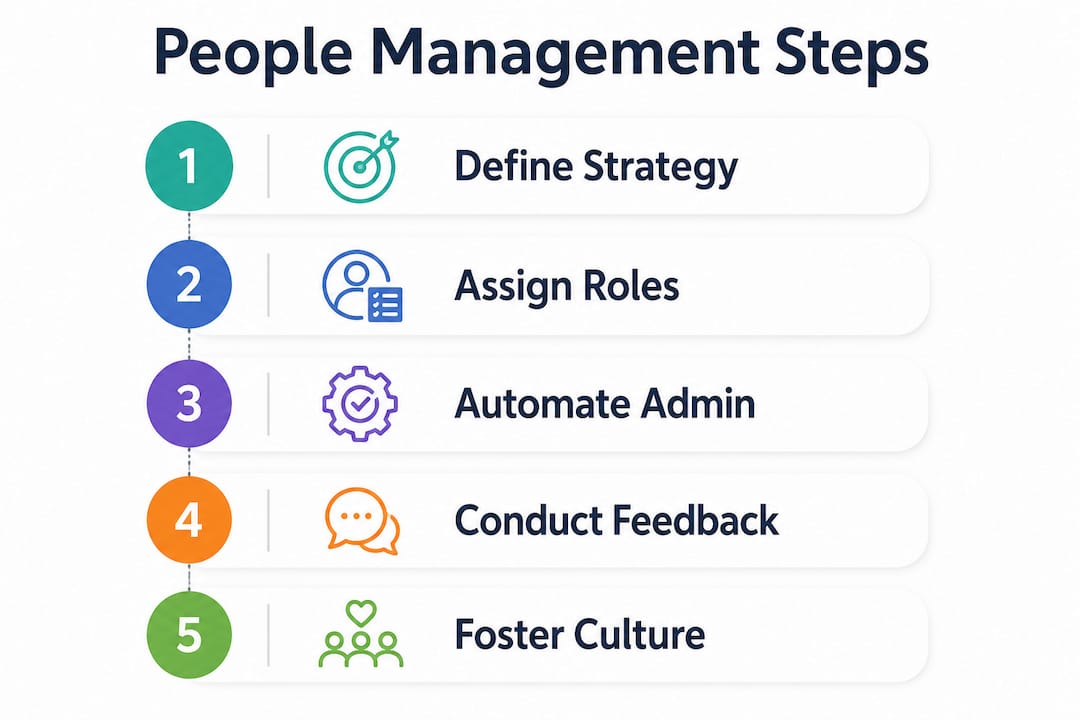
- Managing people without HR involves managers taking full responsibility for onboarding, feedback, coaching, and conflict resolution. They must also establish clear documentation, use technology for administrative tasks, and build a communication rhythm to maintain team health. Assigning a designated People Point Person ensures that critical functions are not overlooked, supporting stronger team management.
People management without HR is the practice of managers and business owners directly owning all core people functions — onboarding, performance expectations, feedback, coaching, and conflict resolution — without a dedicated HR department. This is not a workaround. For millions of small and mid-sized organizations, it is the daily reality. People management is distinct from HR management: HR handles policy and compliance at a structural level, while people management is the tactical, daily work of leading, motivating, and developing your team. Get this distinction wrong and you will either over-delegate to systems that cannot replace human judgment, or under-invest in the people practices that keep teams functional and legally protected.
What is people management without HR?
People management without HR means the manager or business owner becomes the single point of accountability for every people-related decision. There is no one to escalate to, no policy team to consult, and no buffer between you and your team’s needs. People managers bridge strategy and execution, focusing on who does what, how they are supported, and whether they are growing. That is a significant responsibility, and most managers inherit it without formal preparation.
The good news is that the core of effective people management is not complicated. It requires clarity, consistency, and follow-through. Common small business failures stem from lack of formal onboarding and irregular feedback, two things any manager can fix without an HR budget. The absence of HR does not excuse poor people practices. It makes deliberate, structured management even more critical.

A clearly defined people strategy is critical even for small businesses to build a cohesive culture and align talent with business goals. That does not mean writing a 40-page HR manual. It means knowing your team’s strengths, setting clear expectations, and creating a rhythm of communication that keeps everyone aligned. Workforce planning for small teams starts with exactly this kind of intentional thinking.
What are the key responsibilities of people management without HR?
Five functions define effective people management when there is no HR department to share the load:
- Onboarding. A new hire’s first 30 days set the tone for everything that follows. Without HR, you own the welcome, the role clarity, the tool access, and the cultural introduction. A simple onboarding checklist shared before day one prevents the confusion that drives early attrition.
- Setting performance expectations. Every team member needs to know what “good†looks like in their role. Write it down. Vague expectations are the leading cause of performance problems that managers later describe as “attitude issues.â€
- Providing feedback. Regular monthly feedback is the minimum to keep performance manageable and support employees effectively. Monthly is a floor, not a ceiling. Weekly check-ins are better for fast-moving teams.
- Coaching. Coaching is not therapy and it is not performance management. It is the ongoing conversation about how someone is growing in their role. Managers who coach retain better talent.
- Conflict resolution. Without HR, you are the mediator. Address friction early, directly, and with both parties present. Letting conflict fester is the fastest way to lose your best people.
Pro Tip: Designate a “People Point Person†in your organization, even if it is a part-time responsibility. Without a designated People Point Person, critical people functions slip through the cracks and unaddressed friction compounds over time. This person does not need an HR title. They need clear ownership.
Clear role documentation ties all five functions together. When responsibilities are written down and shared, managers spend less time arbitrating confusion and more time developing their team. Skill mapping is one practical way to make role clarity visible and actionable across your team.
How can small organizations handle compliance and admin tasks without an HR team?
Legal compliance does not disappear because you have no HR department. Business owners without HR are fully liable for contracts, workplace policies, and the legal risks that come with employment. Organizations reduce manual overhead with AI agents managing PTO tracking, policy explanations, and onboarding workflows. This is not a future trend. It is already how lean teams stay compliant without a full-time HR hire.
The most practical approach for teams under 20 people is pairing a payroll platform with an AI-driven system of action. For small teams, this combination automates onboarding, offer letters, policy updates, and PTO with far less complexity than enterprise HR software. You get the administrative coverage without the overhead. The role of AI in employee assessment is expanding rapidly, and the same logic applies to compliance workflows.
The table below shows how traditional HR functions map to practical alternatives for organizations managing without a dedicated HR team.
| Traditional HR function | Practical alternative for lean teams |
|---|---|
| Onboarding coordination | Automated checklist via payroll or workflow platform |
| PTO tracking and approval | AI-driven HR system of action integrated with calendar |
| Policy management and updates | Live documentation hub (Notion, Google Docs) with version control |
| Performance review scheduling | Manager-owned calendar cadence with structured templates |
| Contract and offer letter creation | Payroll platform templates reviewed by an employment attorney |
| Conflict resolution escalation | Designated People Point Person with a clear escalation protocol |
The one area where technology cannot fully substitute for human judgment is sensitive conversations. Automated tools handle the administrative layer. The emotional and relational layer still requires a person.
What cultural and communication practices sustain teams without HR?
Culture does not require an HR department. It requires consistent behavior from leadership. Communicating with empathy and building psychological safety through plain language and regular, low-pressure feedback is the foundation of engagement in organizations without HR support. When people feel safe to raise concerns, problems surface early and stay manageable.
A practical communication rhythm for managers without HR looks like this:
- Daily: A brief team check-in, either async or live, to surface blockers and maintain connection.
- Weekly: A short update on priorities, wins, and what is changing. This replaces the “hallway conversation†that remote teams miss.
- Monthly: A one-on-one feedback session with each team member. Focus on growth, not just performance. Ask what is working and what is getting in the way.
Pro Tip: Use plain language in every people conversation. Avoid HR jargon like “performance improvement plan†when you mean “let’s talk about what is not working.†Plain language reduces defensiveness and keeps the conversation productive. Hold space for employee questions without rushing to solutions.
Psychological safety is not a soft concept. Teams with high psychological safety surface problems faster, make fewer repeated mistakes, and retain people longer. You build it by responding to bad news with curiosity instead of blame, and by following through on what you say you will do. Understanding team dynamics gives managers a concrete framework for reading and improving the relational health of their team.
How to build a simple system for managing people operations internally
Every organization without HR needs one central place where people can find answers without asking a manager. A live, plain-language documentation hub reduces routine inquiries and is the single most practical step you can take to manage people operations without formal HR support. Tools like Notion or Google Docs work well. The platform matters less than the commitment to keeping it current.
Your internal people hub should cover at minimum:
- Time off policies. How to request leave, how much is available, and who approves it.
- Reporting lines. Who reports to whom, and who to contact when the direct manager is unavailable.
- Performance expectations. What success looks like in each role, written in plain language.
- Onboarding steps. A checklist new hires can follow independently from day one.
- Escalation paths. What to do when a concern cannot be resolved at the team level.
Assign one person to own this hub. Without clear ownership, documentation drifts out of date and loses its value. The People Point Person is the natural owner. Review the hub quarterly and update it whenever a policy or process changes. Job redesign often surfaces gaps in role documentation that belong in this hub.
The payoff is real. When employees can answer their own questions, managers reclaim time for the higher-value work of coaching and developing their team. A well-maintained hub also signals organizational maturity to new hires, which matters for retention even in small teams.
Key Takeaways
Effective people management without HR requires managers to own five core functions directly, supported by clear documentation, consistent communication, and the right technology for administrative tasks.
| Point | Details |
|---|---|
| Own the five core functions | Managers must handle onboarding, feedback, coaching, expectations, and conflict without delegation to HR. |
| Designate a People Point Person | Assign one person, even part-time, to own people operations and prevent critical tasks from being missed. |
| Use technology for admin tasks | Pair a payroll platform with an AI-driven system to automate PTO, onboarding checklists, and policy updates. |
| Build a plain-language documentation hub | A live, accessible hub in Notion or Google Docs answers routine questions and reduces manager interruptions. |
| Communicate with a consistent rhythm | Daily check-ins, weekly updates, and monthly one-on-ones create the structure that replaces formal HR processes. |
Why managing people without HR is harder than it looks
I have worked with dozens of founders and managers who assumed that “no HR†meant “less process.†It almost always means the opposite. When there is no HR department, every people problem lands on the manager’s desk with no filter and no support structure. The managers who handle it well are not the ones with the most experience. They are the ones who accept the responsibility early and build simple systems around it.
The shift that matters most is moving from control to empowerment. Modern people management shifts from control to empowerment, where managers remove obstacles for employees rather than directing every decision. That shift is harder than it sounds when you are also managing compliance, onboarding, and conflict resolution simultaneously. But it is the only approach that scales.
What I have seen fail consistently is the assumption that empathy and technology are in tension. They are not. AI tools handle the administrative layer so managers have more time for the human layer. The organizations that get this right use technology to free up attention, not to replace it. They also never skip the People Point Person step. Informal handling without a named responsible individual is where people management without HR breaks down fastest.
The uncomfortable truth is that most managers are not undertrained in HR concepts. They are under-supported in the practical execution of people management. The answer is not more training. It is clearer ownership, simpler systems, and a willingness to have the direct conversations that HR departments sometimes absorb on a manager’s behalf.
— Mikk
How Sparkly supports people management for lean teams âš¡ï¸
Managing people without HR means making high-stakes decisions with limited data. Sparkly is a people-intelligence platform built for exactly this situation. It combines psychometric assessments, personality insights, AI analysis, and Human Design data to give managers a clearer picture of who their people are and where they fit best.
Sparkly goes beyond skills and CVs to assess personality first, because skills can be learned but personality drives how someone works, communicates, and handles pressure. For business owners and managers without an HR team, that kind of role and task fit insight replaces guesswork with data. Sparkly also helps you evaluate employee potential before costly mismatches become exits. If you are managing people without HR support, Sparkly gives you the decision-making layer that makes the difference.
FAQ
What is people management without HR?
People management without HR is the direct ownership of all core people functions, including onboarding, feedback, coaching, and conflict resolution, by managers or business owners rather than a dedicated HR department.
What are the biggest risks of managing people without HR?
The biggest risks are legal non-compliance with employment contracts and policies, and unaddressed performance or conflict issues that escalate without a formal escalation path.
How do small teams handle HR compliance without an HR department?
Small teams pair a payroll platform with an AI-driven system of action to automate PTO tracking, onboarding, and policy management, reducing legal risk without the cost of a full HR hire.
How often should managers give feedback without HR support?
Monthly one-on-one feedback sessions are the minimum for effective people management without HR. Weekly check-ins are better for fast-moving or remote teams.
What is the most important first step for managing people without HR?
Designating a People Point Person is the most critical first step. Without a named individual responsible for people operations, essential functions are missed and friction compounds over time.