
HR Without an HR Department: A Guide for Leaders

TL;DR:
- Managing human capital without an HR department involves distributing core functions, with leaders handling onboarding, records, compliance, and reporting. Outsourcing payroll, benefits, and recruiting helps maintain efficiency and legal compliance, while designated individuals address sensitive issues and documentation. Effective leadership and simple systems ensure legal protection, employee trust, and successful people management outside traditional HR structures.
HR without an HR department is the practice of managing human capital through leadership accountability, standardized processes, and technology rather than a dedicated HR team. The term “people operations†is increasingly used to describe this distributed model, where managers absorb core HR responsibilities directly. No federal law requires a company to have HR staff, but HR obligations remain and must be absorbed by someone competent. The U.S. Chamber of Commerce recommends hiring a full-time HR employee around 10 employees, yet thousands of growing businesses operate well past that threshold without one. If you lead one of those organizations, this guide is for you.
What is HR without an HR department?
HR without an HR department means every HR function still exists. It is just distributed. Onboarding, compliance tracking, employee records, performance conversations, and offboarding all continue. The difference is that managers, founders, and designated leaders carry those responsibilities instead of a specialist team.

HR is leadership behavior expressed through transparency, consistency, and fairness, not just policies or paperwork. That framing, articulated by Angela Smith, reframes the entire challenge. You are not replacing HR. You are practicing it differently.
The U.S. Chamber of Commerce guidance is clear: hiring HR staff around 10 employees is the standard recommendation. That threshold signals when HR complexity outpaces informal management. Before you reach it, or if you choose to stay lean beyond it, you need a deliberate system.
What are the key HR functions that must be handled without an HR department?
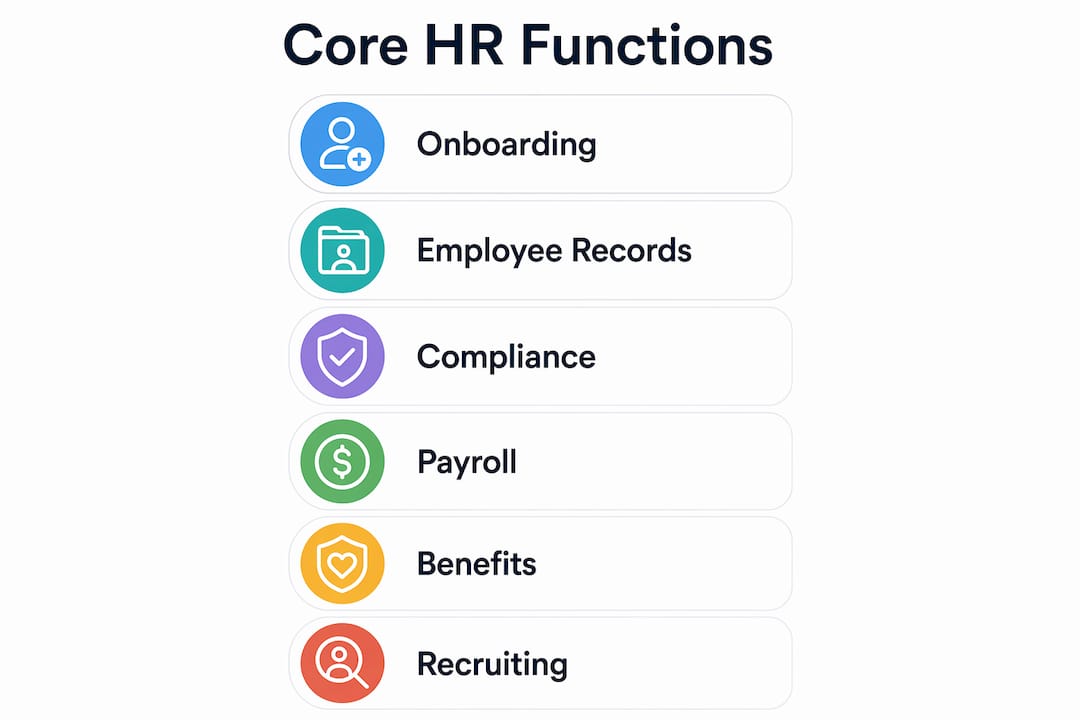
Not all HR functions carry equal risk. Some must stay in-house because they require human judgment, legal accountability, and cultural sensitivity. Others are transactional and can be handled by tools or outsourced partners.
Six core HR functions should be managed in-house when no HR department exists: onboarding, employee records management, compliance tracking, HRIS management, offboarding, and HR reporting. These six touch legal risk, employee trust, and organizational memory directly. Delegating them without clear ownership creates dangerous gaps.
| HR function | Recommended approach |
|---|---|
| Onboarding | Manage in-house; assign a designated owner |
| Employee records | Manage in-house; use a secure digital system |
| Compliance tracking | Manage in-house; review EEOC, DOL, FMLA, OSHA requirements |
| HRIS management | Manage in-house with SaaS support |
| Offboarding | Manage in-house; document every exit |
| HR reporting | Manage in-house; track turnover, headcount, incidents |
| Payroll | Outsource or use a dedicated payroll platform |
| Benefits administration | Outsource to a broker or PEO |
| Recruiting | Use ATS tools or a recruiting partner |
Payroll, benefits, and recruiting are where most HR-less organizations find the most relief through outsourcing. Leveraging technology and outsourcing for these functions improves both efficiency and legal compliance. That frees your managers to focus on the six in-house functions that actually require human judgment.
Pro Tip: Create a one-page “HR Ownership Map†that assigns each of the six in-house functions to a named person. Ambiguity about ownership is where compliance failures start.
What challenges do organizations face when managing HR without a dedicated team?
The risks of running without HR are real and well-documented. Organizations without structured HR support experience higher turnover rates, lower employee satisfaction, and greater risks of unresolved biases and grievances. That finding comes from a 2021 CIPD study. It means the cost of going without HR shows up directly in your retention numbers.
Three specific failure patterns appear most often in HR-less organizations:
- The documentation trap. Managers often fail to maintain consistent documentation without HR oversight, which creates serious legal exposure during disputes and terminations. A verbal warning with no written record is not a warning at all in an employment dispute.
- The exception culture. An “exception culture†emerges when inconsistent policy bending leads to loss of trust and legal risk. When one employee gets flexibility that another does not, without documented reasoning, you have created a fairness problem.
- The empathy gap. Without an HR advocate, people operations can become purely transactional and lose the empathy necessary for healthy employee relations. Employees notice when no one is in their corner.
A fourth risk is governance. The absence of HR creates dangerous gaps when no one is competent and accountable for legal and ethical escalations. A harassment complaint, a termination dispute, or an accommodation request under the Americans with Disabilities Act requires someone who knows what they are doing. “We don’t have HR†is not a legal defense.
“The absence of HR can create dangerous governance gaps when no one is competent and accountable for legal and ethical escalations.†— Jim Stroud
Pro Tip: Assign a named “People Point Person†for sensitive conversations. This does not need to be a full-time role. It needs to be a specific person with clear authority and basic training in employment law.
How can leaders effectively fulfill HR roles without a formal department?
Effective HR management outside a formal department starts with treating HR as a leadership skill, not an administrative burden. The leaders who do this well share four consistent behaviors.
-
Write clear, simple policies and enforce them consistently. A one-page policy on attendance, a one-page policy on performance feedback, and a one-page policy on conduct cover most situations. Complexity is the enemy of consistent enforcement. Use workforce planning principles to think ahead about role needs and team structure.
-
Designate a People Point Person. Successful organizations designate a specific person to ensure empathy and accountability in sensitive conversations when no formal HR exists. This person does not need an HR title. They need trust, discretion, and clear authority.
-
Build a simple documentation system. Create a shared “People Hub,†a folder or lightweight HRIS, where onboarding checklists, performance notes, policy acknowledgments, and exit records live. Every manager contributes to it. Every record is dated and signed. This single habit eliminates most legal risk.
-
Invest in people assessment. Understanding soft skills and personality fit before and after hiring reduces mismatch, friction, and costly exits. When you do not have an HR team to catch problems early, your hiring and role-design decisions carry more weight.
-
Apply expectations evenly. Effective HR is based on transparency, consistency, admitting unknowns, and applying expectations evenly. When you make an exception, document why. When you do not know the answer to an employment question, say so and find out.
The future of HR in lean organizations is a small “elite core†focused on advising and data rather than traditional bureaucracy. That model works when leaders treat HR as a core competency, not a compliance checkbox.
Pro Tip: Schedule a 30-minute monthly “People Review†with your leadership team. Cover turnover signals, open roles, any performance or conduct issues, and upcoming compliance deadlines. Consistency here prevents most crises.
What tools and outsourcing options support HR management without a department?
Technology has made it genuinely practical to run HR functions without a full team. The right combination of SaaS platforms, outsourced partners, and assessment tools covers most of what a small HR department would handle.
The three main support models each have a distinct role:
- SaaS HRIS platforms handle employee records, onboarding workflows, time tracking, and compliance alerts. They give managers a single place to manage documentation without HR expertise.
- Professional Employer Organizations (PEOs) co-employ your staff and take on payroll, benefits, workers’ compensation, and many compliance obligations. This is the highest-coverage outsourcing option for small businesses.
- People analytics and assessment platforms support hiring and talent decisions with data beyond resumes and gut instinct. Sparkly, for example, assesses personality rather than skills alone, because skills can be learned but personality drives behavior. Sparkly merges psychometric assessments, Human Design, AI, and human judgment to produce higher-probability insights for hiring and role-fit decisions. You can explore HR analytics approaches to see how data-driven people decisions work in practice.
| Support method | Best for | Limitation |
|---|---|---|
| In-house manual | Very early stage, under 5 people | Does not scale; high error risk |
| SaaS HRIS | 5–50 employees | Requires setup and consistent use |
| PEO outsourcing | 10–200 employees | Cost; less direct control |
| People analytics SaaS | Hiring and role-fit decisions | Complements, does not replace, process |
Evaluate solutions based on your headcount, the complexity of your roles, and your budget. A 12-person startup needs different tools than a 90-person company managing multiple locations. The goal is not to replicate an HR department. The goal is to cover the six in-house functions reliably and outsource the rest intelligently.
Key Takeaways
HR without an HR department works when leaders treat people management as a core responsibility, not an afterthought, and build simple systems to support it.
| Point | Details |
|---|---|
| HR functions never disappear | Compliance, onboarding, and employee relations persist regardless of whether an HR team exists. |
| Six functions stay in-house | Onboarding, records, compliance, HRIS, offboarding, and reporting require human ownership and accountability. |
| Documentation prevents legal risk | Consistent written records are the single most effective protection during disputes and terminations. |
| Designate a People Point Person | Assigning one named person to sensitive conversations prevents the empathy gap and governance failures. |
| Technology covers the rest | SaaS platforms and PEOs handle payroll, benefits, and recruiting efficiently without in-house HR staff. |
Why HR without a department is a leadership test, not a staffing gap
I have worked with a lot of founders and managers who frame the absence of HR as a resource problem. “We’ll hire HR when we can afford it.†That framing is dangerous. The legal obligations under EEOC, DOL, FMLA, and OSHA do not wait for your headcount to justify a hire.
What I have seen work consistently is leaders who treat HR as a personal accountability, not a department they are waiting to build. They write the policies themselves. They document every difficult conversation. They pick up the phone when an employee is struggling instead of waiting for a formal process to catch it.
The hardest part is not the compliance. It is the empathy. Without a dedicated HR advocate, employees can feel like they have nowhere to go. The best HR-less organizations I have seen solve this by naming a People Point Person early, long before they need one for a crisis.
My honest advice: do not wait until something goes wrong to build your people systems. Start with a simple documentation habit, a clear ownership map, and one person who employees know they can talk to. That is not a substitute for HR. That is the foundation of it.
— Mikk
Sparkly and the HR-less organization
Running HR without a department means every hiring and role-fit decision carries more weight. There is no HR team to catch a bad hire six months in or flag a mismatch before someone quits.
Sparkly is built for exactly this situation. It assesses personality first, because personality drives behavior and skills can be learned. By merging psychometric data, Human Design, AI analysis, and human judgment, Sparkly gives leaders the kind of people-fit insights that reduce costly exits and improve role alignment without requiring a full HR team to interpret the results. You can also explore Sparkly’s work-fit product to see how role and task fit assessments work in practice. When you are the HR department, better data makes you a better one. âš¡ï¸
FAQ
What is HR without an HR department?
HR without an HR department is the distribution of core HR functions, including onboarding, compliance, employee relations, and documentation, across leadership and designated managers rather than a specialist team.
Can a company legally operate without an HR department?
No federal law requires a company to have HR staff, but HR obligations under EEOC, DOL, FMLA, and OSHA apply regardless. Someone in the organization must be competent and accountable for those requirements.
What are the biggest risks of running without HR?
The three most common risks are inconsistent documentation that creates legal exposure, an exception culture that erodes trust, and an empathy gap where employees have no advocate for sensitive concerns.
When should a company hire a dedicated HR person?
The U.S. Chamber of Commerce recommends hiring a full-time HR employee around 10 employees and building an in-house HR team by approximately 100 employees.
How does personality assessment help HR-less organizations?
Personality assessment reduces hiring mismatch and role misalignment before they become costly problems. Platforms like Sparkly assess personality rather than skills alone, giving leaders higher-probability data for hiring and role-fit decisions without requiring an HR specialist to interpret results.