
How Tech Shapes Recruiter Efficiency: A 2026 Guide

TL;DR:
- Technology significantly enhances recruiter efficiency by automating repetitive tasks and enabling new workflows. It delivers large productivity gains but requires process redesign and human judgment to realize its full potential. Combining AI with strategic workflow changes allows recruiters to focus on relationship building and decision-making.
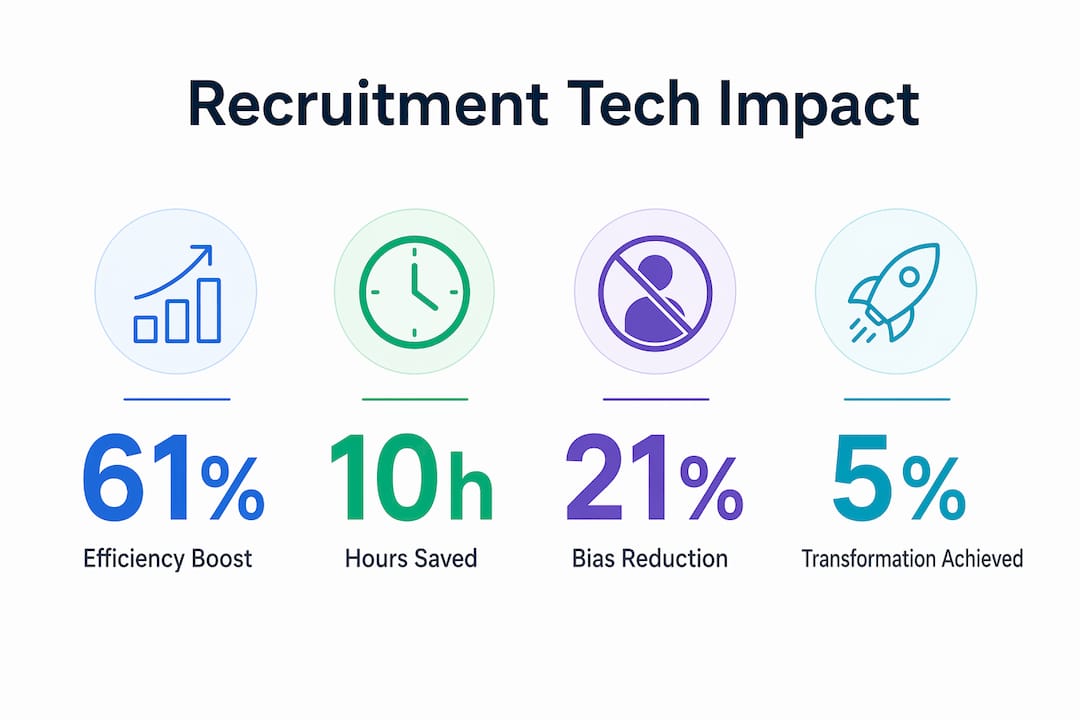
Technology’s role in recruiter efficiency is to automate repetitive tasks, accelerate candidate evaluation, and free recruiters to focus on decisions that actually require human judgment. Research confirms that AI tools carry a statistically significant positive impact on recruitment efficiency (β = 0.61). That number means technology is not a marginal improvement. It is a structural shift in how recruiting work gets done. The industry term for this shift is talent acquisition technology adoption, and understanding it separates recruiters who grow their impact from those who stay buried in scheduling emails and resume stacks.
What is the role of tech in recruiter efficiency?
Technology tools for recruiters fall into five practical categories, each targeting a different friction point in the hiring process.
- AI-assisted resume screening. Screening software scores and ranks candidates against job criteria before a recruiter reads a single line. This cuts initial review time from hours to minutes.
- Automated scheduling. Automated scheduling is 26% faster than manual scheduling. That gap compounds across dozens of open roles.
- AI notetakers. Tools that transcribe and summarize interviews increase timely scorecard submissions by up to 9% and save recruiters up to 10 hours per week. That is a full quarter of a standard work week returned to higher-value work.
- Applicant tracking systems (ATS). A well-configured ATS centralizes candidate data, tracks pipeline stages, and surfaces bottlenecks before they become delays.
- Conversational AI and video assessments. Chatbots handle initial candidate questions and pre-screening. Async video tools let candidates respond on their schedule, which widens the talent pool without adding recruiter hours.
The impact of technology on recruiting is clearest when you look at where time actually goes. Most recruiters spend the majority of their week on coordination, not evaluation. Digital solutions for hiring shift that balance.
Pro Tip: Before adopting any new tool, map your current weekly task list and mark every item that does not require your judgment. Those are your automation targets.
Explore how recruitment technology trends are reshaping hiring models across industries to see which tools are gaining the most traction in 2026.
How do integrated workflows amplify technology gains?
Technology alone does not produce efficiency. McKinsey research shows that AI high performers are 2.8 times more likely to have fundamentally rebuilt their workflows. Fewer than 5% of organizations see real transformation from technology without process redesign. That is the most important number in this article.

The reason is fragmentation. Most recruiting teams bolt new tools onto broken processes. An AI screener feeding into a manual handoff still creates a bottleneck. An automated scheduler connected to a calendar that only two interviewers control still delays offers.
| Approach | Outcome |
|---|---|
| Technology inserted into existing process | Marginal speed gains, same bottlenecks |
| Workflow redesigned around technology | Structural efficiency gains, fewer handoff failures |
| Human review gates added at key decisions | Bias risk reduced, decision quality maintained |
| Siloed tools with no integration | Data duplication, recruiter confusion, slower hiring |
The distinction between executor tasks and orchestrator tasks matters here. Executor tasks are repeatable steps a tool can handle: scheduling, screening, note-taking, status updates. Orchestrator tasks require judgment: evaluating culture fit, advising hiring managers, making final calls on borderline candidates. Recruiters who redesign their workflows explicitly assign executor tasks to technology and protect orchestrator time for themselves.
Adapting workforce models and leadership practices is equally important as the technology itself. A recruiter with great tools and a broken approval chain still misses offers.
Pro Tip: Draw your current hiring process on a whiteboard. Circle every step that does not require a human decision. Those circles are your redesign starting points.
For a deeper look at how job redesign software supports this kind of structural change, Sparkly’s resource covers the leading tools available in 2026.
What are the challenges of using tech in recruitment?
Automation in recruitment processes carries real risks that recruiters need to manage, not ignore.
AI shows only modest improvement in bias mitigation. Research puts the bias mitigation effect at β = 0.21, which is statistically significant but small. That means AI screening reduces some bias but does not eliminate it. Human review at shortlist stage remains non-negotiable.
Trust and transparency present a separate problem. The same research finds that AI’s effect on trust and transparency (β = 0.08) is not statistically significant. Candidates and hiring managers do not automatically trust AI-driven decisions. Recruiters who cannot explain why a tool ranked candidates the way it did lose credibility fast.
Generative AI has also complicated candidate evaluation. Flawless resumes and polished interview answers are now infinitely scalable with AI writing tools. Traditional hiring signals are losing their reliability. Recruiters who rely on resume quality as a proxy for candidate quality are evaluating the candidate’s AI tool, not the candidate.
Common risks and recommended responses:
- Algorithmic bias: Audit screening outputs quarterly. Compare shortlist demographics against applicant pool demographics.
- Over-reliance on automation: Keep a human review gate before any candidate is rejected without a conversation.
- Candidate experience gaps: Automated touchpoints feel cold. Add personalized messages at key milestones like offer stage and rejection.
- Volume overwhelm: AI tools can flood pipelines with applicants. Set minimum qualification thresholds before screening runs, not after.
- Skills-only evaluation: Resumes and AI screeners favor documented skills. Personality, working style, and team fit require a different assessment layer entirely.
Understanding these employer challenges is the first step toward building a recruitment process that technology supports rather than distorts.
How can recruiters implement tech to maximize efficiency?
Practical implementation of technology for improving recruitment efficiency follows a clear sequence. Skipping steps is where most teams go wrong.
- Audit your weekly tasks. List every recurring task. Label each one as executor (repeatable, rule-based) or orchestrator (judgment-required). Aim to automate at least 60% of executor tasks within 90 days.
- Pilot narrow and deep, not broad and shallow. Pick one bottleneck, such as scheduling or note-taking, and fully automate it before moving to the next. Partial automation of many steps produces less gain than full automation of one.
- Build AI literacy actively. Learn prompt engineering for sourcing and job description writing. Practice bias detection by reviewing AI shortlists against your own manual review. The gap between the two reveals where your tool needs calibration.
- Expand your interviewer pool. Time-to-hire delays often come from interviewer availability, not software speed. Adding two qualified interviewers to a panel reduces scheduling friction more than any scheduling tool alone.
- Invest the time saved into relationships. Automation in recruitment processes only pays off if recruiters use the recovered hours on hiring manager alignment, candidate experience, and talent pipeline development. Time saved and then spent on low-value admin is a wasted gain.
- Measure before and after. Track time-to-fill, time-to-screen, scorecard submission rates, and offer acceptance rates. Efficiency gains that are not measured are not sustained.
Tech innovations in talent acquisition work best when recruiters treat themselves as orchestrators of AI workflows rather than users of individual tools. That mental shift changes how you evaluate every new feature a vendor pitches.
Pro Tip: Set a monthly “efficiency audit†on your calendar. Review which tools you used, which saved time, and which added steps. Cut the ones that added steps.
Sparkly’s approach to role of AI in recruitment covers how AI tools can be layered with personality data to produce more reliable hiring signals than automation alone.
Key Takeaways
Technology improves recruiter efficiency most when it automates executor tasks, integrates across the full workflow, and is governed by human judgment at every critical decision point.
| Point | Details |
|---|---|
| AI drives measurable efficiency | AI tools show a β = 0.61 impact on recruitment efficiency, a structural gain, not a marginal one. |
| Automated scheduling saves real time | Automated scheduling is 26% faster than manual, compounding across every open role. |
| Workflow redesign is non-negotiable | Fewer than 5% of teams see transformation from technology without rebuilding their processes. |
| Bias mitigation remains limited | AI reduces bias modestly (β = 0.21) but does not eliminate it. Human review gates are required. |
| Orchestrator skills define recruiter value | Recruiters who shift from executor to orchestrator roles protect their impact as automation grows. |
The recruiter’s role is changing faster than most teams realize
Here is what I have observed working at the intersection of people data and hiring: most recruiting teams adopt technology to do the same job faster. That is the wrong goal. The right goal is to use technology to do a different job entirely.
When scheduling and note-taking are automated, a recruiter’s calendar opens up. The question is what fills it. The recruiters I see thriving in 2026 fill that time with hiring manager coaching, candidate relationship building, and workforce planning conversations. The ones struggling fill it with more applications reviewed manually, because the process was never redesigned.
I am also skeptical of any team that trusts an automated shortlist without a human review layer. The bias mitigation numbers are real but modest. And with generative AI making every resume look polished, the signal-to-noise ratio in applicant pools has dropped sharply. Personality, working style, and energy fit are the signals that AI screeners cannot yet read reliably. That is where human judgment, supported by proper assessment tools, still wins.
The future of recruiting is a hybrid model: AI handles volume and coordination, humans handle judgment and relationships. Recruiters who develop AI literacy now, meaning prompt skills, bias review habits, and workflow design thinking, will be the ones organizations cannot afford to lose.
— Mikk
Sparkly’s approach to smarter, faster hiring
Sparkly is built for recruiters and HR professionals who want more than speed. While automation handles scheduling and screening, the harder problem is knowing whether a candidate will actually thrive in a role. Sparkly addresses that by assessing personality first, not just skills, because skills can be learned but personality drives how someone works, collaborates, and grows.
Sparkly merges human judgment, AI analysis, psychometric assessments, and Human Design into a single computed insight layer. That gives you interview-ready data that goes well beyond what any resume or AI screener can surface. Explore how SaaS transforms HR decisions and see Sparkly’s talent evaluation tools to find the right fit for your hiring workflow. âš¡ï¸
FAQ
What is the measurable impact of AI on recruiter efficiency?
AI tools show a statistically significant positive impact on recruitment efficiency (β = 0.61). That effect is large enough to represent a structural change in how recruiting work gets done, not just a speed improvement.
How much time can automation save a recruiter each week?
AI notetakers alone can save up to 10 hours per week by handling interview transcription and scorecard submissions. Automated scheduling adds further time savings by cutting coordination cycles by 26%.
Does AI eliminate bias in recruitment?
AI reduces bias modestly, with research showing a β = 0.21 effect. That improvement is real but limited. Human review at the shortlist stage remains necessary to catch what automated screening misses.
Why do so few organizations see transformation from recruitment technology?
Fewer than 5% of organizations achieve transformation from technology alone. McKinsey research shows that rebuilding workflows around technology, rather than inserting tools into existing processes, is what separates high performers from the rest.
How does AI affect candidate evaluation quality?
Generative AI has made polished resumes and interview answers widely accessible, which reduces the reliability of traditional hiring signals. Recruiters need assessment methods that go beyond resume quality to evaluate personality, working style, and role fit directly.