
Employee Performance Review Explained for Managers

TL;DR:
- Regular, continuous feedback improves the accuracy and fairness of employee performance evaluations.
- Effective reviews involve structured discussion, goal assessment, and documented follow-up to foster growth.
An employee performance review is a formal, structured evaluation where a manager assesses an employee’s work performance, strengths, and development needs within a defined period. Most managers treat it as a once-a-year event. That single mistake is why 90% of HR professionals report that traditional annual reviews fail to produce accurate results. The performance evaluation process works only when it is embedded in a continuous feedback culture, not treated as a standalone meeting. This guide covers every component of an effective review, from structure and cadence to common pitfalls and the step-by-step conversation itself.
What does an employee performance review actually cover?
An employee performance review is not just a rating form. It is a structured dialogue built on evidence collected over time, covering goal achievement, behavioral competencies, and forward-looking development. The industry term for the broader system is performance management, and the review is one formal checkpoint within it.

The most effective reviews assess four things: what the employee achieved against agreed goals, how they achieved it (behaviors and competencies), where they have clear strengths, and where focused development would create the most growth. Skipping any one of these four areas produces a review that feels incomplete to the employee and is hard to defend to HR.
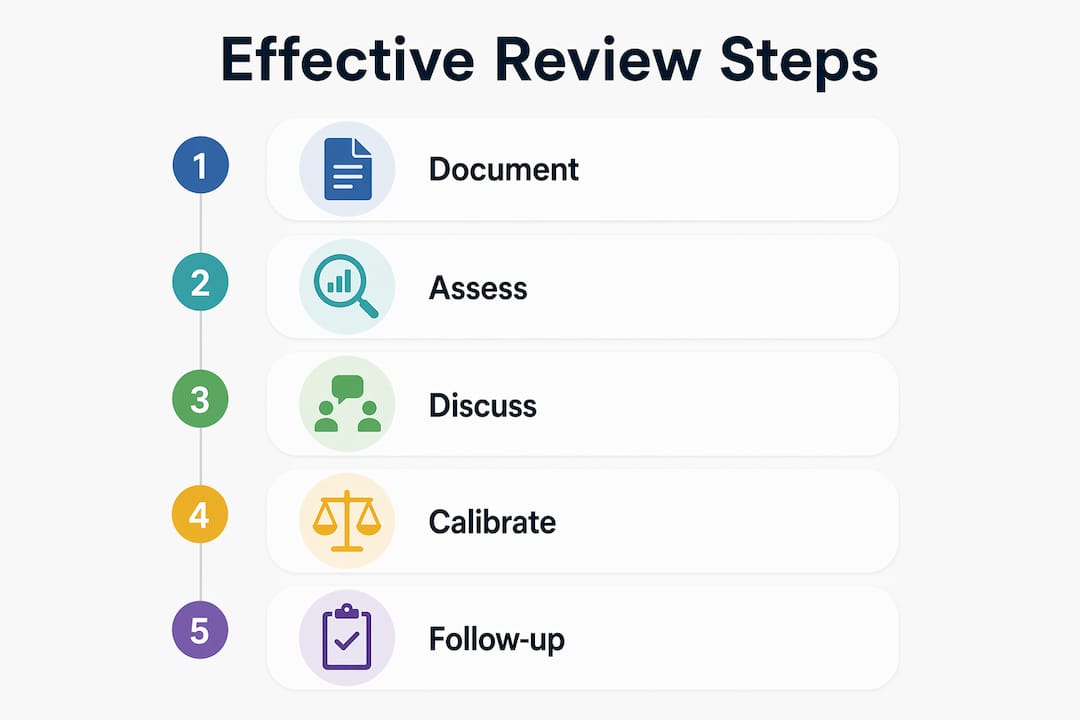
Documentation matters as much as the conversation itself. Review outcomes shared within 48 hours of the meeting produce significantly better follow-through and accountability. Managers who wait a week to write up notes find that details fade and employees lose momentum.
What are the core components of an effective performance review?
A well-built review has six components. Each one serves a specific purpose, and removing any of them weakens the whole structure.
- Goal assessment. Evaluate performance against the specific goals set at the start of the review period. Use concrete examples, not general impressions.
- Competency review. Assess how the employee works, not just what they produced. Communication, collaboration, and decision-making all belong here.
- Employee self-assessment. Ask the employee to evaluate themselves first. Starting with self-assessment turns the review into a collaborative diagnostic rather than a one-sided judgment.
- Strength statements. Include 3–5 specific strength statements supported by real examples. Vague praise like “great team player†carries no weight.
- Growth areas. Limit growth feedback to 2–3 areas. More than three overwhelms the employee and dilutes focus.
- Development plan. Attach timelines, specific actions, and named resources (mentors, training programs, stretch assignments) to every growth area.
The SBI model (Situation, Behavior, Impact) is the most reliable framework for writing both strength and growth statements. It forces specificity: describe the situation, name the exact behavior, and explain the impact it had on the team or business.
Pro Tip: Collect notes on employee performance throughout the year in a running document. A log of 40–50 data points collected over time produces a far more accurate and defensible review than memory alone.
Managers who spend 30–45 minutes drafting each review consistently produce higher-quality evaluations. That time investment signals to the employee that their development is taken seriously.
How does review frequency affect accuracy and engagement?
Review cadence is one of the most debated topics in performance management, and the data is clear. Annual reviews are the minimum viable cadence, bi-annual reviews are the common starting point for formal processes, and quarterly check-ins are the recognized best practice for mid-sized and scaling teams.
Here is why frequency matters so much:
- Annual reviews suffer from recency bias. Managers unconsciously weight the last 60–90 days of performance over the full year. A single strong quarter can inflate an otherwise average year, and one rough patch can unfairly drag down a strong performer.
- Bi-annual reviews reduce recency bias but still miss real-time course correction. An employee who struggles in month three gets no formal feedback until month six. That is a long time to drift in the wrong direction.
- Quarterly check-ins create a feedback rhythm. Managers and employees align on goals, address blockers early, and arrive at the formal annual review with no surprises on either side.
- Ongoing one-on-ones fill the gaps between formal reviews. Weekly or bi-weekly one-on-ones are where informal feedback, recognition, and coaching happen. They feed directly into the formal review cycle.
- Continuous documentation supports fair evaluations. When managers log observations in real time, the annual review reflects the full year rather than the most recent memory.
The shift from annual to quarterly check-ins is not just a scheduling change. It changes the entire relationship between manager and employee from evaluator and subject to coach and collaborator. That shift is where engagement gains come from.
What are the most common mistakes managers make in performance reviews?
Most performance review failures trace back to a small set of repeatable mistakes. Knowing them in advance is the fastest way to avoid them.
- Overloading one meeting with a year of feedback. A single conversation cannot carry 12 months of unaddressed observations. Employees shut down when feedback volume exceeds what they can absorb in one sitting.
- Mixing compensation and development in the same conversation. Combining pay discussions with developmental feedback triggers defensive responses. Employees stop listening to coaching the moment a salary number enters the room. Schedule these as separate meetings.
- Using vague, non-actionable language. Phrases like “needs improvement†or “could communicate better†tell the employee nothing useful. Feedback must connect directly to the employee’s career goals to motivate real change.
- Skipping calibration. Without calibration sessions where managers align on rating standards, a “meets expectations†rating in one team can mean something entirely different in another. Calibration is the defining factor that separates fair performance systems from inequitable ones.
- Relying on subjective impressions instead of documented evidence. Bias enters reviews through gut feeling. Evidence-based reviews, built on a log of specific observations, are both fairer and more legally defensible.
Pro Tip: Before your next review cycle, run a calibration session with peer managers. Agree on what “exceeds expectations†looks like with a concrete example. That 30-minute conversation prevents months of rating disparity.
The goal of a performance review is not to deliver a verdict. It is to give the employee a clear picture of where they stand and a credible path forward. Every mistake on this list pulls the review away from that goal.
How to prepare, conduct, and follow up on a performance review
A strong review conversation follows a clear sequence. Skipping steps at any stage reduces the value of the entire process.
- Prepare thoroughly. Spend 30–45 minutes reviewing your observation log, goal records, and any 360-degree feedback. Aim to enter the meeting with a log of 40–50 data points collected across the full review period. Prepare your SBI-formatted strength and growth statements in advance.
- Open with the employee’s self-assessment. Ask the employee to share their own view of the period before you share yours. This surfaces alignment gaps early and signals that the review is a two-way conversation, not a monologue.
- Deliver feedback using the SBI model. State the situation, describe the specific behavior, and explain the impact. “In the Q3 product launch (situation), you coordinated cross-functional timelines without being asked (behavior), which kept the project two weeks ahead of schedule (impact).†That is a strength statement the employee can build on.
- Review goals met, goals missed, and forward-looking priorities. Be direct about both. Employees respect honesty more than diplomatic vagueness.
- Co-create the development plan. The employee should leave the meeting knowing exactly what they are working on, what support they will receive, and when you will check in next. Named resources (a specific training course, a named mentor, a stretch project) make the plan real.
- Document and share within 48 hours. Write clear notes covering the key discussion points, agreed goals, and next steps. Share them with the employee promptly. Documentation shared within 48 hours produces measurably better follow-through.
| Review stage | Key action | Common mistake to avoid |
|---|---|---|
| Preparation | Build a log of 40–50 data points | Relying on memory from the last 90 days |
| Opening | Start with employee self-assessment | Launching straight into manager feedback |
| Feedback delivery | Use SBI model with specific examples | Vague language like “needs improvement†|
| Goal review | Address met and missed goals directly | Glossing over missed goals to avoid tension |
| Development plan | Name specific actions, resources, timelines | Leaving growth areas without a clear next step |
| Follow-up | Share written notes within 48 hours | Delaying documentation until details fade |
The employee potential evaluation conversation sits naturally inside this structure. Managers who assess not just what an employee achieved but how their personality and working style align with their role get far richer data for development planning.
Key takeaways
An effective employee performance review requires continuous documentation, structured feedback using the SBI model, and a clear separation between compensation and development conversations.
| Point | Details |
|---|---|
| Annual reviews are not enough | Quarterly check-ins are the best practice for reducing recency bias and improving accuracy. |
| Self-assessment opens alignment | Starting with the employee’s view turns the review into a collaborative conversation, not a verdict. |
| Calibration ensures fairness | Managers must align on rating standards together to prevent disparity across teams. |
| Document within 48 hours | Sharing written notes promptly after the meeting drives accountability and follow-through. |
| Connect feedback to career goals | Vague feedback is ignored; feedback tied to the employee’s own ambitions motivates real change. |
Why most performance reviews miss the point entirely
Performance reviews get a bad reputation because most of them are designed to evaluate the past rather than build the future. I have seen this pattern repeat across teams of every size: the manager spends the meeting delivering a verdict, the employee spends it defending themselves, and both leave feeling like the hour was wasted.
The reviews that actually change behavior share one quality. They treat the conversation as a diagnostic tool, not a report card. When you start with the employee’s self-assessment, you learn something you could not have known from your own observation log alone. You find out where the employee’s perception of their performance diverges from yours. That gap is where the real coaching work lives.
Calibration is the piece most managers skip because it requires coordination with peers. That is a mistake I have learned to stop making. Without calibration, your “strong performer†rating means nothing if the manager across the hall gives the same rating to someone performing at a completely different level. Fairness is not just a values question. It is a retention question.
The separation of compensation and development conversations is the single change that produces the fastest improvement in review quality. The moment salary enters the room, the employee’s brain shifts from learning mode to negotiation mode. Keep them separate and you get a genuine development conversation instead of a defensive one.
Finally, the reviews that produce the most growth are the ones that do not end when the meeting does. A written summary shared within 48 hours, a follow-up check-in scheduled before the employee leaves the room, and a named mentor or training resource attached to each growth area. Those three habits turn a one-hour meeting into a six-month development arc.
— Mikk
How Sparkly supports smarter, fairer performance evaluations
Traditional performance reviews rely on manager memory, gut feeling, and inconsistent rating standards. Sparkly takes a different approach by adding personality data, psychometric insights, and role-fit analysis to the evaluation picture. âš¡ï¸
Sparkly merges inputs from psychometric assessments, Human Design, AI analysis, and human observation to surface higher-probability insights about how an employee is wired, not just what they have done. That data gives managers a richer foundation for development conversations and makes calibration across teams far more objective. Managers using personality-focused assessment strategies move from evaluating past performance to predicting future fit. If you want to see how HR SaaS tools can make your review process more accurate and development-focused, Sparkly is built exactly for that.
FAQ
What is an employee performance review?
An employee performance review is a formal evaluation where a manager assesses an employee’s achievements, strengths, and development needs within a defined period. It is one structured checkpoint within the broader performance management process.
How often should performance reviews be conducted?
Quarterly check-ins are the recognized best practice for scaling teams, with annual reviews as the minimum cadence. More frequent reviews reduce recency bias and improve the accuracy of evaluations.
What should a performance review include?
An effective review includes goal assessment, competency evaluation, employee self-assessment, 3–5 strength statements, 2–3 growth areas with development plans, and documented follow-up shared within 48 hours.
Why should compensation and development be discussed separately?
Mixing pay and development feedback triggers defensive responses that prevent employees from absorbing coaching. Separating the conversations produces more receptive and productive development discussions.
What is calibration in performance reviews?
Calibration is a process where managers align on rating standards together before finalizing scores. Calibration prevents rating disparity caused by subjective bias and ensures employees are evaluated fairly across the organization.